We'll stop promoting S'pore as tourist spot
By Desmond Ng
THEY'VE already boycotted the sale of Singapore Airlines (SIA) tickets in India.
Their next target - stop promoting Singapore as a tourist destination.
Over 2,000 travel agents in several cities in India took to the streets last Friday to protest against SIA's move to scrap commission on ticket sales last November.
Over 1,000 agents participated in the march at Kochi in the southern Indian state of Kerala, 500 agents in Delhi and Bangalore and close to 400 agents marched for approximately 3 km in South Mumbai with banners.
Some 200 agents participated in the action at Kolkata and Chennai. About 150 agents marched in Pune and 40 agents marched in Lucknow.
SIA is the largest foreign carrier operating in India.
The message to SIA - pay us our 5 per cent commission or face the consequences.
But SIA, along with major carriers including Lufthansa and Air France, have said no because of the high cost of jet fuel.
They have told agents to charge the commission to customers instead.
Singapore next casualty?
But should the standoff with SIA continue any longer, the next casualty could well be Singapore, warned the Travel Agents Federation of India (TAFI) national general secretary Ajay Prakash.
He said that the trade will decide to withdraw its support to promote Singapore as a travel destination if the situation does not improve.
Mr Prakash told The New Paper yesterday: 'We want to impress that this could escalate into a bigger situation where we stop facilitating movement to Singapore. We want Singapore Tourism Board (STB) to appeal to SIA to pay the commission.'
He said the federation met an STB representative in India last Thursday to discuss the standoff.
'It's in no one's interest if the standoffs continue. Tourists from India is a key market for Singapore.
'About 779,000 tourists from India travelled to Singapore last year. But this can only come if the trade does actively promote the country,' he said.
About 10.1 million visitors visited Singapore last year, with tourism revenues reaching a record $14.8 billion.
Visitors from India, Indonesia, China, Australia and Malaysia accounted for about 50 per cent of total arrivals.
But these numbers are expected to drop this year due to the global downturn.
Said Mr Prakash: 'Everybody realises that travel has slowed down. It's in no one's interest to have this boycott.
'We all need to be selling tickets and making money. I am not in the business of running protest and boycotts.'
They last met SIA representatives in December but the dispute was not resolved.
For now, travellers in India will have to get their tickets direct from SIA or through online travel portals that are not part of the protest.
They can also travel on other carriers to Singapore.
SIA spokesman Stephen Forshaw said that the company has been in touch with the travel agents in India on the issue of transaction fees in place of commissions and the company remains committed to continue their dialogue with them.
The boycott has not hurt the company significantly.
Said Mr Forshaw: 'For example, our fare specials in India that ran from 29 Dec 2008 to 15 Jan 2009 for travel to Singapore and beyond received a very good response. We are seeing a shift on the part of customers to booking online more now.'
He said that not all travel agents are participating in the boycott, and indeed, many are still booking tickets for their customers on Singapore Airlines flights.
Customers can also buy tickets direct from the SIA website.
Said Mr Forshaw: 'Since the 'boycott' started, we have noticed an increase in sales generated via our website.
'The key message to those travel agents who think this boycott is having an effect is that they are taking business away from their own community and driving it to our website.'
Under the commission model, the airline pays the agent a fixed percentage of the basic fare, irrespective of the services provided by the agent to the customer.
The agent who provides a better level of service receives the same amount as one who provides a basic service.
SIA believes that this is an outdated model and many travel markets worldwide, including here in Singapore, have moved away from this, in favour of service fee-based models.
The STB could not respond by press time.
This article was first published in The New Paper on Feb 6, 2009.
Sunday, February 08, 2009

Friday, February 06, 2009
Prataman and his Helpers
CPA of President Nathan, Mr Lim Chee Onn, Mr Po'ad Bin Shaik Abu Bakar Mattar, Mr S Dhanabalan, Mr J Y Pillay, Prof Cham Tao Soon, Mr Yong Pung How, Mr Goh Joon Seng and Mr Stephen Lee Ching Yen.
Thursday, February 05, 2009
Prataman's Job
What were the President’s reasons for approving the reserves, and what process did he go through to approve it?
Below is an excerpt from the report by Channel NewsAsia:
“The concern arises over the way the 2—key system operates. It seems the 2—key system operates simultaneously at the same time. When the government key says “unlock”, the other key unlocks automatically,” said Low Thia Khiang, MP for Hougang.
Mr Tharman said: “This is not a ’wayang’ (show)… The point is: the President, advised by the CPA (Council of Presidential Advisers), makes an independent and careful judgement on the government’s case.”
MP for Tampines GRC, Irene Ng, said: “Can I ask the minister whether the process can be refined and improved further so that in future we can make the process more transparent — that the public knows that the institution of the President is one that is strong, and that it can exercise an independent turn of the key.”
Inderjit Singh, MP for Ang Mo Kio GRC, said: “What’s missing is the process that the President took after he got briefed by the government. If we could get a sense of what they discussed and what process they went through to decide, then this may clear many of these questions.”
But Mr Tharman said: “I’m not sure why it is relevant. At the end of the day, this is a system that is different from Norway and Australia, where as much detail as possible is provided.
“This is a system that relies on trust in the individuals who are in charge, including those appointed to the CPA and the Elected President. Do you trust them? Have they made decisions wisely? Has the government been acting responsibly?”
Do you trust them? Have they made decisions wisely? Has the government been acting responsibly?
Sunday, February 01, 2009
Just for laughes
This psychiatrist walks into his waiting room and sees two men. One is hanging upside down from the ceiling. The other is sawing an imaginary piece of wood. The doctor approaches the man who is sawing and asks him what he is doing.
'I'm sawing wood,' the man replies.
'And what's your friend doing?' the doctor asks.
'Oh, he thinks he's a light bulb.'
'Well, don't you think you should tell him to get down? The blood is rushing to his head.'
'What, and work in the dark?'
'I'm sawing wood,' the man replies.
'And what's your friend doing?' the doctor asks.
'Oh, he thinks he's a light bulb.'
'Well, don't you think you should tell him to get down? The blood is rushing to his head.'
'What, and work in the dark?'
Tuesday, January 27, 2009
Prataman's message to Singaporeans
Speaking at the Singapore Chinese Chamber of Commerce & Industry's (SCCCI) annual Lunar New Year gathering, Mr Nathan said Singaporeans should take heart from the fact that the Republic was facing the downturn in a stronger position than in previous recessions.
'Our economy is more diversified. Our banking sector, while not immuned to the global financial turmoil, remains sound,' he said.
'Companies have stronger balance sheets and are less leveraged. Households have low debt, and income has also increased across the board.'
He also added that the Government is in a 'strong fiscal position', having been prudent over the years and built up reserves during the years of growth.
'So while we cannot avoid the painful impact of a recession, we are in a good position to weather the downturn,' added Mr Nathan.
Last week, for the first time ever, the Government said it will be tapping into its past reserves to help pay for this year's Budget expenditure.
Finance Minister Tharman Shanmugaratnam said in his Budget Statement last Thursday that the Government is doing so in order to have 'full flexibility' to respond to the current economic crisis.
Mr Nathan has already given his in-principal approval for the Government to draw $4.9 billion from the reserves.
The money is to fund two measures aimed at saving jobs and keeping businesses here afloat in this downturn.
While the Govehrnment has announced a significantly expansionary Budget, with many aspects focused on helping businesses cut costs and build capability, Mr Nathan urged the business community to continue working together to tackle the challenges ahead.
'For us to do well coming out of this crisis...Industry associations and business chambers can help to reach out to many of our companies who are members,' he added.
'We need to continually emphasize to them that employees and employers have to work together to cut costs and save jobs. Companies need to do their part and take necessary steps to build capability and remain competitive so that they will emerge stronger from the downturn.'
Commending the SCCCI for playing a role in the local business circles, Mr Nathan said: 'The SCCCI has always played a leading role by rallying the business community to respond to national challenges. This partnership with the Government is even more critical during these unusually difficult times.'
Looking forward to the Lunar Year of the Ox, he reminded members and guests of its significance.
'I am told there is now a popular Chinese saying...meaning the Ox can turn around Heaven and Earth,' he said.
'Let us hope the Year of the Ox will help us take whatever hardships, as the Ox is reputed for.'
Thursday, January 22, 2009

Wednesday, January 21, 2009
The Change has arrived 2009

The world welcomes the first Black African American, the 44th President of the United States, Barack Hussein Obama.
God Save the World.
Tuesday, January 20, 2009
Busy Days for our top men
President Nathan Confers Top Military Award on Crown Prince of Brunei
His Royal Highness Prince Haji Al-Muhtadee Billah, the Crown Prince of Brunei Darussalam and Senior Minister at the Prime Minister's Office, was conferred Singapore's highest military award, the Distinguished Service Order (Military) [or Darjah Utama Bakti Cemerlang (Tentera)], by President S R Nathan at an investiture held at the Istana today.
The Distinguished Service Order (Military) was awarded to His Royal Highness in recognition of his significant role in enhancing the excellent defence ties between Brunei Darussalam and Singapore. Under His Royal Highness' guidance, the close and longstanding ties between the defence establishments of both countries have strengthened. The defence ministries of Singapore and Brunei Darussalam haveinitiated linkages through new professional initiatives such as the Singapore-Brunei Defence Scholars Exchange Programme. Bilateral exercises and professional interactions between the Royal Brunei Armed Forces and the Singapore Armed Forces have also increased in scope and complexity.
Guests present at the investiture included Minister for Defence Teo Chee Hean, Minister for Education and Second Minister for Defence Ng Eng Hen, Minister of State for Defence Koo Tsai Kee, Permanent Secretary (Defence) Chiang Chie Foo, Chief of Defence Force Lieutenant-General Desmond Kuek, other senior government officials and military officers from both countries.
As part of his visit, His Royal Highness also called on President S R Nathan at the Istana, and met with Senior Minister Goh Chok Tong, Minister Mentor Lee Kuan Yew and Minister for Defence Teo Chee Hean. His Royal Highness will call on Prime Minister Lee Hsien Loong at the Istana tomorrow.
His Royal Highness is in Singapore for a four-day official visit from 19 to 22 January. He is accompanied by Yang Amat Mulia Pengiran Muda Abdul Qawi.
Monday, January 19, 2009
Singapore Govt may tap reserves
The President of Singapore finally got his chance to do his job - Look after the National Reserves. Release or Not?
ONE of the country's sacred cows could be slaughtered during the Budget this Thursday as the Government mulls over a move to dip into Singapore's rainy-day savings: the national reserves. The leaders are now considering the unprecedented step of drawing from the reserves to fund the aggressive pain-relief measures needed in this downturn, Senior Minister Goh Chok Tong disclosed yesterday.
'The issue which the Prime Minister and the Minister of Finance are now thinking over, is whether we should go to the President and ask him for approval to use the reserves for extraordinary measures,' he told reporters after giving out $100 hongbao and goodies to the poor in his Marine Parade constituency.
But he also cautioned: 'It's a difficult decision because once you do that, you may open the reserves for future demands, which may not justify the use of reserves.'
On Friday, Prime Minister Lee Hsien Loong had said the Budget will run into a deficit this year and if necessary the Government will dip into the reserves.
He told reporters: 'The Government's job is not to do everything which is asked for but to see which are the items which will be most effective and then how do I raise the money to fund all the things which I need to do, either from the Budget revenues this year or from the reserves.'
Last year, the Government had modified the rules to allow it to spend a larger chunk of investment returns from the reserves.
In 1999, in the aftermath of the Asian financial crisis, the Government had shied away from dipping into reserves, even in the face of a $5 billion Budget deficit. Mr Goh was the prime minister then.
Yesterday, however, he pointed out that a 'muscular response' in the upcoming Budget is needed as these are exceptional times - and the key issue is to save jobs.
'There must be exceptional measures for exceptional times,' he said.
He gave a sampling of the dire economic news coming in, noting the sharp dive in export figures last month. Singapore's exports plunged 21 per cent in December, the biggest fall in almost seven years. At PSA, 30 per cent of the cranes are sitting idle.
'The weather is so bad, and we've always said the reserves are for a rainy day. If this is not a rainy day, I don't know what is a rainy day,' he said.
Asked how much money the Government may take out of the reserves, he said the amount did not matter. What was important was that the measures justified the use of reserves.
The Government has a hefty war chest to turn to. The reserves include assets managed by the Government of Singapore Investment Corporation (GIC), as well as those owned by the Monetary Authority of Singapore (MAS) and Temasek Holdings.
As of September last year (08), the MAS' foreign exchange reserves were valued at about $240 billion. GIC's portfolio is valued at well over US$100 billion (S$148 billion). Temasek Holdings' portfolio is worth $185 billion but its assets are not covered by the constitutional amendment on net investment returns.
MPs contacted gave mixed responses to unlocking the reserves.
Dr Muhammad Faishal Ibrahim (Marine Parade GRC) and Mr Liang Eng Hwa (Holland-Bukit Timah GRC) said they were in favour if the money was well spent. Mr Liang said using the money to build up the economy and workforce is akin to investing in a different asset.
Mrs Josephine Teo (Bishan-Toa Payoh GRC) however said she would rather wait first to see how bad the crisis gets.
'The conservative part of me says we really do not know how long this crisis is going to last. Will we risk running out of ammunition when we most need it?'
Financial analysts contacted backed any move to open up the war chest. That, they said, would spur a more aggressive Budget.
Said Dr Chua Hak Bin, Citigroup's head of Singapore equity research: 'We were concerned that the Budget was not going to be aggressive enough because of the constraint of having a balanced Budget.'
Nanyang Technological University economist Tan Khee Giap said that factoring in expenditure at the beginning was better than introducing off-Budget measures later. 'We should budget for the worst and hope for the best,' he said.
Sunday, January 18, 2009
Tense / Messy dark region - Pakistan Vs Indian, Sri Lanka Vs Tamil Tigers
How Sri Lanka's President Mahinda Rajapaksa reacted when heard of attack on Lasantha
Just a few hours after Lasantha Wickrematunge was shot dead in a busy Colombo street last week his elder brother, Lal, rushed to the pioneering journalist's home.
Lasantha, the editor of Sri Lanka's The Sunday Leader newspaper, had warned Lal a few days earlier that the Government would try to kill him, and told him about a cupboard containing all his sensitive documents.
Rifling through it, Lal piled the papers into a plastic bag. Only later, as he read through them, did he realise that one was the handwritten draft of an obituary that Lasantha had prepared for himself, explicitly accusing the Government of assassinating him.
That extraordinary obituary, published in the The Sunday Leader, is now making waves around the world and spotlighting the assault on the media that has accompanied Sri Lanka's military campaign against the Tamil Tiger rebels since 2006.
“When finally I am killed, it will be the Government that kills me,” said the obituary entitled And Then They Came For Me. “Murder has become the primary tool whereby the state seeks to control the organs of liberty. Today it is the journalists, tomorrow it will be the judges.”
Under President Rajapaska the Army has made unprecedented gains against the Tigers, whose 25-year struggle for an ethnic Tamil homeland has claimed more than 70,000 lives.
The army captured Kilinochchi, the Tigers' capital, on January 2, and is now on the brink of a conventional military victory as troops close in on the rebels' last outpost in Mullaitivu.
Lasantha, however, was one of a small group of critics who accused the Government of systematically eroding civil liberties since a 2002 truce unravelled four years later.
A member of the ethnic Sinhalese majority, he also criticised the Government for failing to find a lasting political solution to address the Tamil minority's concerns.
“He was a lone dissenting voice,” said Sonali Samarasinghe, Lasantha's second wife, whom he married three weeks ago. “He was perceived as denigrating the Government's so-called victory.”
Lasantha knew the risks: he had survived other attacks, including the burning of his newspaper's printing press in 2007, and was used to regular death threats. Dilrukshi Handunnetti, the Leader's investigations editor, showed The Times an envelope that he received three days before he died.
It contained half a page of his newspaper with a message in red paint daubed across a critical story on Kilinochchi's capture. “If you continue to write this, you'll be killed,” the message said.
Be that as it may, on the morning of Thursday, January 8, President Rajapakse was busy with meetings at Temple Trees. At a meeting of four associations related to the coconut industry the President had been talking with key industrialists about the problems facing them in the present economic scenario.
The meeting was attended by the Coconut Product Exporters Association, the Coir Products Association, the Horticultural Exporters' Association and the Poultry Association where representatives of these bodies were making presentations setting out the current problems facing exporters.
While the Coconut Product Association presentation was being made by its representatives Rajapakse was to get a phone call. He would listen attentively interjecting only once to say 'oluwatada wedune' before terminating the call.
Immediately assuming the matter related to the military drive in the north and wondering if the President would be in a mood to continue with a coconut exporters' presentation the representative asked 'Can I continue Sir?' at which time Rajapakse told him to please continue his presentation.
In fact when a representative from the Poultry Association observed during the meeting that due to certain constraints they were better off doing business in Singapore, Rajapakse was to say jokingly 'then we should send you to Singapore.'
However when it was time to ask questions President Rajapakse had told those present, 'I'm hungry, aren't you'll hungry let's go out and eat.'
Tuesday, January 13, 2009
Earning a top salary for lazing around a beautiful tropical island
When I saw the title, I thought they are mentioning our PrataMan! TOP Salary, Lazing around, Tropical Island...
An Australian state is offering internationally what it calls "the best job in the world" -- earning a top salary for lazing around a beautiful tropical island for six months. The job pays 150,000 Australian dollars (105,000 US dollars) and includes free airfares from the winner's home country to Hamilton Island on the Great Barrier Reef, Queensland's state government announced on Tuesday.
In return, the "island caretaker" will be expected to stroll the white sands, snorkel the reef, take care of "a few minor tasks" -- and report to a global audience via weekly blogs, photo diaries and video updates.
The successful applicant, who will stay rent-free in a three-bedroom beach home complete with plunge pool and golf buggy, must be a good swimmer, excellent communicator and be able to speak and write English.
"They'll also have to talk to media from time to time about what they're doing so they can't be too shy and they'll have to love the sea, the sun, the outdoors," said acting state Premier Paul Lucas.
"The fact that they will be paid to explore the islands of the Great Barrier Reef, swim, snorkel and generally live the Queensland lifestyle makes this undoubtedly the best job in the world."
Lucas said the campaign was part of a drive to protect the state's 18 billion Australian dollar a year tourism industry during the tough economic climate caused by the global financial meltdown.
"Traditional tourism advertising just doesn't cut it sometimes and we are thinking outside the box by launching this campaign."
Queensland Tourism Minister Desley Boyle said some people might question whether it was risky to let an unknown person become an unofficial tourism spokesperson for the state.
"I think the biggest risk will be that the successful candidate won't want to go home at the end of the six months," she said.
"This is a legitimate job which is open to anyone and everyone."
Applications are open until February 22. Eleven shortlisted candidates will be flown to Hamilton Island in early May for the final selection process and the six month contract will commence on July 1.
Job-seekers can apply on .
Monday, January 12, 2009
Britain's Prince Harry apologises for racist language
Come on - everyone has some degree of Racist in them... Give him a break.
LONDON, (AFP) - - Britain's Prince Harry has apologised for using racist language after a Sunday newspaper reported he had filmed himself calling an army colleague a "Paki" and telling another he looked like a "raghead".
The video obtained by the News of the World plunges the 24-year-old prince, the third in line to the throne, into fresh controversy four years after he sparked outcry by wearing a Nazi swastika at a fancy dress party.
The newspaper posted the video on its website and said it was made in 2006 when the prince was still an officer cadet.
It begins as he is waiting with his platoon in an airport departure lounge for a flight to a training exercise in Cyprus.
Touring the room with a video camera as his colleagues snooze, he spots an Asian cadet and says: "Anybody else around here?... Ah, our little Paki friend, Ahmed."
"Paki" is a racist term for Indians or Pakistanis.
The royal family issued an apology, but insisted the prince had used the term without malice.
"Prince Harry fully understands how offensive this term can be, and is extremely sorry for any offence his words might cause," a spokesman said.
"However, on this occasion three years ago, Prince Harry used the term without any malice and as a nickname about a highly popular member of his platoon.
"There is no question that Prince Harry was in any way seeking to insult his friend."
The report said Harry made the "raghead" remark -- a racist term for Arabs -- while on the exercise.
Once again he is behind the camera when he spots one of his comrades with camouflage netting over his head and as he looks up at the lens, Harry says: "It's Dan the Man... Fuck me, you look like a raghead."
The royal spokesman said: "Prince Harry used the term 'raghead' to mean Taliban or Iraqi insurgent."
The prince served with the army battling the Taliban in Afghanistan last year but was forced to return home after his security was compromised when a carefully arranged media blackout on his deployment was broken.
Harry, an army lieutenant, is to begin training soon as a combat helicopter pilot.
Britain's equalities watchdog, the Equality and Human Rights Commission, said the racism claims "appear to be disturbing allegations".
"We will be asking the MoD (Ministry of Defence) to see the evidence, share that evidence with us and their plans for dealing with it," a spokeswoman said.
"We will then consider what further action might be necessary."
A spokeswoman for the Ministry of Defence said: "Neither the Army nor the Armed Forces tolerates inappropriate behaviour in any shape or form.
"The Army takes all allegations of inappropriate behaviour very seriously and all substantive allegations are investigated.
"We are not aware of any complaint having been made by the individual," the spokeswoman said, referring to "Ahmed".
She added: "Bullying and racism are not endemic in the Armed Forces."
In another clip from the three-minute video, Harry pretends to make a mobile phone call to his grandmother, Queen Elizabeth II.
He says: "Granny, I've got to go. Send my love to the corgis. And grandpa... God Save You... yeah, that's great. See you, bye."
It is not the first time that the youngest son of Prince Charles and the late Princess Diana has been forced to apologise for his actions.
His decision to attend a friend's fancy dress birthday party wearing a swastika armband in 2005 sparked widespread criticism. The publication of photographs of that incident was followed by a swift apology from the royals.
In the past, it emerged he had smoked cannabis as a teenager and he was once involved in a scuffle outside a nightclub with a paparazzi photographer, but in recent years Harry has sought to shake off his 'playboy prince' reputation.
He is heavily involved in a charity in Lesotho to support children orphaned by AIDS which was launched in memory of his mother, and is patron of several other children's charities.
Friday, January 02, 2009
Wednesday, December 31, 2008

Monday, December 22, 2008
Unhappy Indian Voice
I have always warn you guys about the DARK force...
http://singaporeindianvoice.blogspot.com/2008/12/singapore-has-lowest-gdp-but-highest.html
Singapore has lowest GDP but highest paid PM in the world! Highest Paid Presidents / PM's around the WorldSource: The Mango Blog
The Economic recession has hit one and all, salary cuts and pink slips have taken their toll on the common man. Presidents, Prime Ministers are no exception. Most of the heads have cut down on their salaries or are planning to do so in the near future. Lets take a look at what the heads of top nations are earning.
Lee Hsien Loong, Singapore (Country GDP: $235.6 billion - 2008)Politicians in Singapore are amongst the most highly paid government officials in the world. Lee Hsien Loong, Prime Minister of Singapore earns five times more than the American President. Lee Hsien Loong takes an annual salary of $2.46 million.
Unhappy Indian Voice, how about President Nathan???
I add in for you...
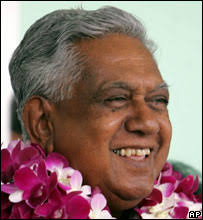
CLP do nothing, earn Singapore Dollar $3 million.
http://singaporeindianvoice.blogspot.com/2008/12/singapore-has-lowest-gdp-but-highest.html
Singapore has lowest GDP but highest paid PM in the world! Highest Paid Presidents / PM's around the WorldSource: The Mango Blog
The Economic recession has hit one and all, salary cuts and pink slips have taken their toll on the common man. Presidents, Prime Ministers are no exception. Most of the heads have cut down on their salaries or are planning to do so in the near future. Lets take a look at what the heads of top nations are earning.
Lee Hsien Loong, Singapore (Country GDP: $235.6 billion - 2008)Politicians in Singapore are amongst the most highly paid government officials in the world. Lee Hsien Loong, Prime Minister of Singapore earns five times more than the American President. Lee Hsien Loong takes an annual salary of $2.46 million.
Unhappy Indian Voice, how about President Nathan???
I add in for you...
CLP do nothing, earn Singapore Dollar $3 million.
Sunday, December 21, 2008
Indian police given moustache pay
Police in a district in India's Madhya Pradesh state are being paid to grow moustaches because bosses believe it makes them command more respect.
Ten policemen in the northern state are already receiving 30 rupees (66 US cents) every month for their efforts.
Jhabua district police chief Mayank Jain told BBC News Online: "The response is growing and in the months ahead we expect to see more moustachioed policemen.
"Moustaches are improving the personalities of our constables. They are acquiring an aura of their own. They are creating a positive impression on the local people and getting a lot of respect."
'Motivation'
The police chief hit upon the idea of moustaches-for-cash after a seminar attended by district policemen and local people.
"There were two or three moustachioed constables in the gathering and I saw people were looking at them very respectfully and pleasantly. That is when I thought of making more policemen grow moustaches," Mr Jain said.
The decision to pay them a whisker more every month for their efforts was just a "little motivation", he said.
Mr Jain said he was keeping a watch on the shape of the moustaches so that they did not look too intimidating, and so have the opposite effect on people.
"It takes time to keep a proper moustache. A good one has to take a turn near the angle of the upper lip," Mr Jain said.
He said that in the next few months many more of the 1,100 policemen at the district's 22 police stations would begin sporting moustaches.
Men in rural India have traditionally sported impressive moustaches to assert their masculinity.

Saturday, December 20, 2008
The Great Moustaches

The extravagant beards and moustaches proudly sported by generations of Indian men are under threat, according to a new book that celebrates the country's finest facial hair.
As India rapidly modernises, clean chins are becoming the rule among young people, said the book's author, Richard McCallum, who spent months on the road documenting the bushiest bristles he could find before they disappear forever.
With photographer Chris Stowers, McCallum scoured markets, festivals and villages to gather specimens now collected in their book Hair India - A Guide to the Bizarre Beards and Magnificent Moustaches of Hindustan.
"It was an idea that started out as a bit of fun but turned into a labor of love," said McCallum, 30, a British travel business operator who has lived in Delhi for four years.
"Beards and moustaches tell the story of modern India - how it is becoming a more Westernized, homogenized place, but also how the traditions and the love of display still exist."
"Male grooming is important to Indians, and facial hair proved a topic that took us to places and into conversations with people we would never have met otherwise."
The book, illustrated with hundreds of photographs, divides facial hair into categories including "the chin strap", "the soup strainer", "the wing commander" and "the walrus".
Among those pictured are both the world's longest beard, measuring 1.6 meters, and the world's longest moustache, at 11 foot-6 inches.
The record-breaking moustache is a big earner for Ram Singh Chauman, 54, who charges modeling fees and whose whiskers have starred in Bollywood films and even had a cameo in the Bond film Octopussy.
But the stars of the book are perhaps the ordinary stall-owners and rickshaw drivers showing off moustaches and beards that are cut, dyed, waxed and preened in an endless variety of shapes and sizes.
"Some people were confused when we first told them why we wanted to take their picture, but they soon became very keen," said Stowers.
McCallum and Stowers' search took them from camel fairs in Rajasthan to the Himalayan town of Leh, and from the banana groves of the Western Ghats to military tattoos in the capital New Delhi.
Along the way, they demonstrated their commitment to the job by discarding their razors, with McCallum growing an unruly black beard and Stowers sprouting a moustache which he tweaked into sharp upwards curls.
Sikhs, for whom "kesh" (uncut hair) is a religious principle, feature heavily in the book, and moustaches remain a professional requirement for the doormen of five-star hotels.
But otherwise the traditional belief that facial hair is a sign of virility appears to be facing the chop.
"Young people don't want an itchy moustache or beard which they think makes them look old," said Lalan Singh, 40, a restaurant doorman in Delhi's and the owner of a handlebar moustache
Thursday, December 18, 2008
Poor Indian FTs - Not paid again
Familiar case of Indian workers not paid
Singapore: Indian Migrant Workers Protest(Singapore) Sat, Jul 01, 2006 Indian Migrant Workers Protest
16 July 2004, more then 150 Indian migrant workers protested peacefully to claim 4 to 6 months salaries owned by their employer. This is the second protest by workers from Wan Soon Construction to claim their salaries amounting to some $4000 to $6000. 28 June 2004 200 Indian Workers protest at Indian Embassy On 28 June 2004, the Indian migrant workers gathered to demand that the Indian Embassy assist them to claim the salary own to them.
----> NOW
04 December 2008
THEY had run away, alleging their employers had not paid them and locked them in a 'cage' when there was no work.
The Ministry of Manpower (MOM) has now resolved their claims. It found that these foreign workers with San's Marine Engineering Service, Han's Marine and K7 Engineering had not been not paid in full and has made sure that they received their full salaries.
But its investigations also revealed that not all of the workers' claims were true.
It found their complaints of no work and no pay over a long period to be unfounded.
In a statement issued yesterday, the ministry said it had resolved the salary claims involving 48 Bangladeshi workers from the three companies.
According to the statement, the companies had work contracts with shipyards but there were intermittent periods during which some workers were not deployed to work.
Instead, they were either given training to prepare them for skills tests or sent for re-training because their work standards did not meet those of the shipyards.
They were not paid their full salaries during these periods when they did not work, and there were also unauthorised salary deductions made by their employers. But the workers have since been paid, including for the training periods and for the deductions, after the MOM intervened.
The New Paper had reported on the workers' plight on 4 Oct. The men ran away in September after complaining that they had not been given work or their wages.
They also said they had had enough of being locked inside a fenced-up area, which they dubbed 'the cage', next to their employers' Tuas office during the day.
One of them, Mr Md Zakir Hossain Md Yousuf Ali, 24, had told The New Paper that they were made to sit in there day after day.
He said through a translator: 'We stayed in the cage the whole day doing nothing. We were not allowed to lie down or sleep.
'If we did, the bosses would scold us or pour water on us. They treated us like animals.'
Mr Md Zakir Hossain, who was employed by Han's Marine, claimed they were sent to the 'cage' as their bosses did not want them to be seen doing nothing at the dormitory during the day.
He said the same thing happened to subsequent batches of workers who arrived in Singapore.
But the HR manager of San's Marine denied any wrongdoing or ill-treatment of its workers, saying the fenced-up area was meant for training workers.
'Not a cage'
An MOM spokesman said yesterday that its investigations 'showed that it was not a cage, but an enclosed area in the company premises'. However, she did not say whether the workers were put in there as they had claimed.
The workers were listed as marine trades workers in their work permits. Once in a while, some would be deployed to do cleaning or general work for other companies, Mr Md Zakir Hossain claimed.
'Even when they sent us to do some work, we didn't get any pay. The company would deduct money for food, lodging and even laundry,' he claimed.
He paid an agent more than $8,000 to get a work permit to work here.
On this point, the MOM noted that many of these workers paid their Bangladesh agents money as security deposits for their job placements here. It has forwarded the names of these agents to the Bangladesh Embassy for further investigation and action.
The New Paper understands that some of the workers have found jobs with other companies.
When contacted yesterday, Mr Joy Kumar, 28, said he was paid $615 after the MOM intervened.
Although he felt it wasn't enough for his six months at San's Marine, he was happy that the MOM had helped him and some of the others find jobs.
He started working at another company yesterday, earning $16 a day.
'I am very happy that I can work and earn money,' he said.
Employers must ensure that they have work for the foreign workers they employ and make prompt salary payments.
First-time offenders can be fined up to $1,000 per charge. For repeat offenders, the fine is up to $2,000 per charge, or a jail term not exceeding one year or both.
They can also be barred from hiring new foreign workers if they are found guilty.
Sunday, December 14, 2008

Friday, December 12, 2008
More Indian FTs in Sink
The National Development Ministry (MND) has on Wednesday released the details of another 10 temporary dormitory sites for foreign workers.
The 10 sites, comprising 3 vacant state buildings and 7 vacant state lands, will provide an additional 20,000 bed spaces.
The 3 state properties which will be converted into temporary dormitories are the former Queenstown Polyclinic at 51 Margaret Drive, the former CAAS office at 1801 Upper Changi Road North, and the existing CPG Corporation Airport Development Division at 1800 Upper Changi Road North.
The former Queenstown Polyclinic and the former CAAS office will house 150 construction workers each. MND said these two temporary dormitories will be ready in about 3 to 6 months.
After the CPG Airport branch is vacated in 3 to 6 months' time, it will be tendered out for the development of a temporary dormitory for 800 construction workers.
The 7 state lands which can be developed into temporary dormitory sites are located in or near industrial estates. The sites are at Mandai Road, Old Choa Chu Kang Road, Hougang Avenue 3, Seletar West Farmway which is located in Jalan Kayu, Jurong Road and Kim Chuan Road.
Their leases have been kept to not more than 6 years.
MND said it has consulted the area's Members of Parliament (MPs) and grassroots organisations in the past two months on the development of the sites into temporary dormitories.
It added that several measures will be put in place to minimise the inconveniences posed by the dormitory developments. These include requiring the dormitories to have adequate facilities for workers, appointing a liaison officer as a point of contact for the grassroots organisations, and conducting educational programmes to inform workers of the social norms and laws in Singapore.
The government is also engaging the MPs and grassroots leaders of existing areas with very high foreign worker populations to identify and implement appropriate measures.
The temporary dormitories are part of the government's efforts to provide proper housing for foreign workers, while more purpose built dormitories come on stream over the next few years.
Thursday, December 11, 2008
India Upgrades Security - Patch
India will create an FBI-style national investigative agency, beef up security and streamline intelligence gathering after a string of lapses _ and a torrent of criticism _ tied to the deadly Mumbai attacks, the top security official said.
The Mumbai attacks that left 171 people dead revealed glaring gaps in the nation's security systems and a shaky intelligence apparatus that missed several warning signs of the siege, which lasted for three days and paralyzed much of India's largest city.
Home Minister Palaniappan Chidambaram, the country's top law enforcement official, acknowledged serious failures Thursday. He outlined a new approach to fight terror in the government's first detailed response since an unprecedented outpouring of public anger and a hail of calls for urgent reform.
Besides creating the National Investigation Agency, Chidambaram said India would strengthen coastal security, improve training of local police, draft tighter anti-terror laws and improve intelligence sharing.
"Given the nature of the threat," he said, "we can't go back to business as usual."
India's intelligence failures were among the most troubling missteps in the attacks, and Chidambaram said Thursday, "We have identified the gaps."
India's foreign intelligence agency had heard as recently as September that Pakistan-based terrorists were plotting attacks on Mumbai, according to a government intelligence official familiar with the matter.
The information, intercepted from telephone conversations apparently coming out of Pakistan, indicated that hotels might be targeted, said the official, who spoke on condition of anonymity because he was not authorized to discuss the details.
India had also received intelligence of a waterborne attack from the United States. The terrorists reached Mumbai's coast on a dinghy, after hijacking a boat, authorities say.
"I have found that there is a tendency to treat some intelligence inputs that are not specific or precise as not actionable intelligence," Chidambaram said. "There is a need to make intelligence gathering and intelligence sharing more effective and result-oriented."
Another change announced Thursday was creation of regional hubs for the National Security Guards, the commando force that led the fight against the 10 gunmen who attacked sites across Mumbai.
The NSG is currently based near New Delhi, and it took nearly 10 hours for the commandos to reach Mumbai _ one of several problems analysts have cited in the response to the attacks.
The commandos "are hampered by the distance between their headquarters and the airport, the absence of a dedicated aircraft, and the poor logistics" in the field, he said.
Chidambaram also said new commando units from the state police would be trained in 20 counterinsurgency and anti-terrorism schools across the country.
Some experts said Chidambaram's speech to Parliament was as much about politics as security.
"This is a predictable response from the government...but it may not be enough to deal with the challenges of India's security," said C. Uday Bhaskar, a prominent defense analyst in New Delhi.
"This is really piecemeal at this point. We need something that is pre-emptive that will prevent problems," he said.
He said some of the changes, like creating new hubs for the commandos, were long overdue, and others, like improving maritime security, were important, but not innovative enough.
These changes "presume that the next attack will be a repeat" of the Mumbai siege, he said. "We need a total revamp."
Chidambaram said a new Coastal Command would be responsible for the security of India's 7,500-kilometer coastline.
The 10 gunmen who attacked Mumbai were Pakistanis trained by the banned Pakistan-based militant group, Lashkar-e-Taiba. Pakistan has arrested at least 20 people, including two extremists alleged by India to be instrumental in the Mumbai siege, but India has made it clear it wants to see more action.
The lone surviving gunman, Mohammed Ajmal Kasab, 21, is in Indian custody and has been repeatedly interrogated by Indian authorities.
He is being held on 12 offenses, including waging war against the country, murder, and other offenses, but he has not yet been formally charged, said Rakesh Maria, Mumbai's chief investigator.
Wednesday, December 10, 2008
Indian Vs Pakistan - WAR!!!?
ISLAMABAD - PAKISTAN said on Tuesday it would not hand over any suspects in the Mumbai bombings to India and warned that while it wanted peace with its neighbour, it was ready for war if New Delhi decided to attack.
The remarks come amid mounting tensions between the nuclear-armed neighbours after India said it is keeping all options open following last month's carnage in Mumbai, where 172 people were killed and more than 300 wounded.
'We do not want to impose war, but we are fully prepared in case war is imposed on us,' Pakistan Foreign Minister Shah Mehmood Qureshi said.
'We are not oblivious to our responsibilities to defend our homeland. But it is our desire that there should be no war.'
Indian officials say the hardline Lashkar-e-Taiba group, which is based in Pakistan despite being banned by the government, is behind the bloodshed, and Indian media have suggested there could be Indian strikes on militant camps.
Mr Qureshi said he was sending 'a very clear message' that his country did not want conflict with India.
'We want friendship, we want peace and we want stability - but our desire for peace should not be considered Pakistan's weakness.'
The minister also said that India's demands for the extradition of suspects in the Mumbai attacks were out of the question and that Pakistan, which has arrested 16 people since Saturday, would keep them on home soil.
'The arrests are being made for our own investigations. Even if allegations are proved against any suspect, he will not be handed over to India,' Mr Qureshi said. 'We will proceed against those arrested under Pakistani laws.'
India and Pakistan have fought three wars since independence from Britain and nearly came to a fourth in 2001 after an attack on the Indian parliament that was blamed on Lashkar-e-Taiba (LeT), which means Army of the Pious.
Under international pressure to act, Pakistan on Sunday raided a camp run by a charity, Jamaat-ud-Dawa, that many believe has close links to Lashkar-e-Taiba, and arrested 15 people.
The charity is headed by LeT's founder Hafiz Saeed.
The LeT has been banned by Pakistan, but India accuses Islamabad of not cracking down on the group, which was established to fight Indian rule in Kashmir and has past links to Pakistani intelligence services and Al-Qaeda.
Mr Saeed on Monday condemned the arrests, saying the Pakistan government had shown 'weakness by targeting Kashmiri organisations'.
Two of the three India-Pakistan wars were fought over disputed Kashmir, which is controlled in part but claimed in whole by both nations, and the United States in particular has urged calm after the bloodshed in Mumbai.
Pakistan authorities were meanwhile said to be questioning a 16th man, Zaki-ur-Rehman Lakhvi, who was arrested Saturday. Indian media say the lone surviving attacker named him as a key planner behind the Mumbai attacks.
India has said that all 10 of the gunmen who carried out the brazen assault on Mumbai, the country's financial capital, were from Pakistan.
The attackers, some of whom arrived by boat, targeted two luxury hotels, a hospital, a Jewish centre and other sites. They managed to hold off Indian security forces for 60 hours before nine were killed and one was captured.
Referring to the arrests in Pakistan, the United States - which counts Pakistan as a vital ally in the 'war on terror' - on Monday welcomed what it said were 'some positive steps' taken by Islamabad. -- AFP
Can you guys Please Calm down...
Friday, December 05, 2008
Now I know...
05-12-2008, 01:54 AM
SAMURAISAN Alfrescian
Join Date: Aug 2008
Posts: 237
My Reputation:Points: 25 / Power: 7
Let's avange Hwei Yen !!
Yeah...let's kill a few Pakis and rape a few Paki women.
Singaporeans must act.
05-12-2008, 02:01 AM
saratogas Alfrescian
Join Date: Jul 2008
Posts: 131
My Reputation:Points: 10 / Power: 6
Re: Let's avange Hwei Yen !!
Yah Rite,
As if you can differentiate who is Paki, Indian, Banglas... all look the same to me.
Life is about Payroll and Claims - $$$
05-12-2008, 02:03 AM
annexa Alfrescian (S)
Join Date: Aug 2008
Posts: 536
My Reputation:Points: 36 / Power: 10
Re: Let's avange Hwei Yen !!
Banglas are dark skinned. Pakis are Muslim and fair skinned. Indians are mostly Hindus.
Wednesday, December 03, 2008
Prataman welcomes top Muslim
Mawlana Hazar Imam is greeted by President S R Nathan at the Istana in Singapore. Photo: Akbar HakimThis morning, Mawlana Hazar Imam attended a meeting with President S R Nathan at the Istana, the official residence and office of Singapore’s Head of State.
This was followed by a visit to the Singapore City Gallery which offered insight into the concept planning activities of Singapore's Urban Redevelopment Authority. Hazar Imam was hosted by the Authority’s CEO, Cheong-Chua Koon Hean.
Later on, Mawlana Hazar Imam also received a tour of Singapore’s Asian Civilisations Museum from the museum’s Deputy Director of Curation and Collections, Tan Huism.
In the evening, Mawlana Hazar Imam was the guest of honour at a dinner hosted by the Minister-in-charge of Muslim Affairs, Dr Yaacob.
Tuesday, December 02, 2008
The problem between India And Pakistan
Its not a religious, race, language or terror problem, its in their blood. They live to disagree.
I was recently reading the chapter, 'India and the Bomb' of the book 'Argumentative Indian' by Amartya Sen and I was quite moved and enlightened too as it highlighted the devil hidden in the nuclearisation of nations, especially long time enemies and brothers, India and Pakistan. I've used the term brothers since both of us share the same kind of people with similar thoughts. If you go anywhere abroad, you'll find Indians and Pakistanis being the best friends. Although we become totally different when we reach our home countries.
Going back to the early days of the bomb, the father of the atoic bomb, J. Robert Oppenheimer qouted the bhagawad Gita after his team,Los Alamos tested the atom bomb, in the trinity test in New Mexico.
"If the radiance of a thousand suns were to burst at once into the sky, that would be like the splendor of the mighty one. Now I am become Death, the destroyer of worlds."
That was the reaction of the father of the son, which went out to kill around 200,000 people instantly during World War II.
In response to the nuclearization of china, India tested its first atomic bomb at pokharan in 1974, followed by the nationalist BJP, which then went on under the guidance of Dr. A P J Abdul Kalam to test six more bombs in 1999. Our brother turned foe, Pakistan then replied with the testing of 6 more. The Indo-Pak nuclear cold war had begun then.
The 2001-2002 India-Pakistan standoff was a military standoff between India and Pakistan that resulted in the amassing of troops on either side of the International Border (IB) and along the Line of Control (LoC) in the region of Kashmir. This was the second major military standoff between India and Pakistan following the successful detonation of nuclear devices by both countries in 1998 and the most recent standoff between the nuclear rivals.
Indian Foreign Affairs Minister Jaswant Singh said on June 5 that India would not use nuclear weapons first, while Musharraf said that he would not renounce Pakistan's right to use nuclear weapons first. In December 2002, Musharraf said he warned India "not to expect a conventional war from Pakistan" if troops crossed the Line of Control in Kashmir. India's Defense Minister replied that India could "take a bomb or two or more but when we respond there will be no Pakistan."
That was the first time the clouds of nuclear war gloomed over Asia as both countries were preparing for the worst. But when I read this, it was the first time I doubted lord Krishna's argumemt with Arjuna of the righteouness of war. Krishna insisted Arjuna to fight, irrespective of its consequences of the war. But the consequences of a genocide would cease to heal in two countries already plagued by poverty and a host of other economic problems.
The consequences have been best described the Arundhati Roy, in a phrase mentioned in 'The Argumentative India'Our cities and forests, our fields and villages will burn for days. Rivers will turn to poison. The air will become fire. The wind will spread the flames. When everything there is to burn has burned and the fires die, smoke will rise and shut out the sun. The earth will be enveloped in darkness. There will be no day. Only interminable night. Temperatures will drop to far below freezing and nuclear winter will set in. Water will turn into toxic ice. Radioactive fallout will seep through the earth and contaminate groundwater.
Most living things, animal and vegetable, fish and fowl, will die.These lines are the perfect representation of the consequences of a nuclear war, which makes Lord Krishna's argument of war, totally nullified.
Monday, December 01, 2008
Old habit - India blames Pakistan
True to habit, India started blaming Pakistan for the terrorist attack on it soil even before the day was out – this time for the condemnable events of Mumbai.
Several facts should provide a reality check. First, the Russians have revealed they had provided advance information to New Delhi about the attacks, but the Indians did not respond.
Second, the BBC interviewed a cook who works for Leopold Café where the terrorists initiated their operations. He said that six or seven people had come to the joint, got something to eat, along with alcoholic beverages but refused to pay, saying in English they had no money (Nov 27). After getting drunk, they started firing at the people in the vicinity.
If these were Lashkar-i-Taiba operatives or some other Muslim extremists, they would never have consumed liquor because Islam forbids that. Also, the Lashkar has denied any involvement. It may be interesting to recall that in March 2000, when President Bill Clinton had reached India on a state visit, 36 Sikhs were massacred by a group of people dressed in Indian army uniforms, as partly narrated by another correspondent (Nov. 23).
That time too Pakistan-based militants were blamed. However, an eyewitness had revealed that these people had been drinking. A subsequent inquiry by a retired Indian judge had found Indian agencies responsible for the killings. The obvious reason for this deceit was to prove to the dignitary that Pakistan was abetting terrorism, so as to get it declared a state sponsor.
Fortunately, Mr Clinton was able to see through this Indian game and has been quoted by his secretary of state as saying it was the work of Hindu militants. But, this slap on New Delhi’s face hasn’t ended its propensity to defame Pakistan.Similarly, after the attack on Indian parliament, Islamabad was blamed and one of the suspects, a Kashmiri man named Afzal Guru, was sentenced to die. But, some Indian human rights activists had shown the police findings to be wrong and demanded his release.
Third, Indian security people claim to have arrested one of the Mumbai terrorists, saying he is a Pakistani named Ajmal Amir Kamal hailing from Faridkot in Multan (Nov 28). However, a BBC correspondent visited the area and found that there is no such village near Multan. There is one near Khanewal having 2,000 residents, but they said nobody by this name ever lived there (Nov 28).
Fourth, for some of the past cases Hindu fanatics have now been found responsible, such as Lt Col Purohit. In fact, the chief of Mumbai’s anti-terrorist squad, Hemant Karkare, who unfortunately got killed in the latest episode, had reportedly been threatened by some of these Hindu extremists after he found leads to their culpability. From the foregoing facts, it would be prudent to investigate highly trained Hindu militants with army links, for the Mumbai carnage.
Indian FT scared no Job
Since he came here three years ago, Indian welder R. Baskaran, 25, has developed a ritual of visiting Little India every Sunday for a meal with friends and some shopping. For the past month, however, he has added a new activity to his Sunday itinerary - a visit to the temple. 'I pray that I will not lose my job. At work, I hear other workers talking about the company losing business and how they may fire people. I don't want to be sent home,' said the native of Tamil Nadu state.
Foreign workers have not been spared the jitters from talks of layoffs and pay cuts since the global financial turmoil hit Singapore last month. They fear that they will be the first to go in the event of massive retrenchment.
Although employers interviewed by The Sunday Times said they have not let their foreign workers go, they may have to if the economy gets worse.
Said the manager of a construction firm, who declined to be named: 'If we do not have projects to work on, how can we continue employing so many workers?'
The warning signs are already there. In a recent dialogue with Malay grassroots leaders, Prime Minister Lee Hsien Loong said he expected the number of foreign workers to stabilise or fall in most sectors with the economic slowdown.
The construction industry is expected to be hit hard, said
Singapore Contractors Association Limited (Scal) executive director
Simon Lee, 'especially with private sector property developers post-poning building projects'.
The industry employs over 300,000 foreign workers. Latest figures show there are around 580,000 foreign labourers here and some 180,000 domestic maids.
A Ministry of Manpower (MOM) report in February said foreign workers are needed to fill jobs during the boom years - and they are the ones who will be shed in larger numbers in an economic downturn.
From 2001 to 2003, when Singapore was affected by the Sars crisis, foreign employment contracted by 71,600.
In 1998, following the Asian financial crisis, more than 7,000 foreign workers had their work permits cancelled because employers, affected by the downturn, had defaulted on levy payments, said MOM.
Maids, too, are worried about losing their jobs. Indonesian maid Nini Kuyadi, 25, has been warned by her employer that she may be sent home if he is retrenched.
'I feel very sad. I still want to work and support my parents back home,' she said.
During the last Asian financial crisis, the number of complaints from maids who were not paid nearly doubled from 165 in 1997 to 302 in 1998, MOM figures showed.
Many were sent home or returned to agencies to be transferred to another employer.
Some agencies are already seeing employers with financial troubles returning their maids.
In the past month, Mr Wilson Wang, director of Workforce International, has seen three or four such cases.
'These employers work as insurance and property agents, and they are badly affected by the crisis. There are also retrenched expats who cannot keep their maids because they have to leave the country,' he said.
Other maid agencies foresee there will be more such cases next year, when the economy is expected to worsen.
Service staff, too - many from the Philippines and China - worry for their future in Singapore.
With foreign visitor arrivals in Singapore falling for the third straight month in August, there could be retrenchments in restaurants and shops, said analysts.
Filipino service staff Angeline D., 28, is already looking for jobs in Dubai just in case she loses her customer service job in the telecommunications industry here.
'I can't afford to be out of job because I'm supporting my family back home. I will go any place that is willing to hire me,' she said.
Sunday, November 30, 2008
Mumbai attacked - India's 9/11
This was not terror – not as Indians understood it, anyway. This was war.
The killers stormed the streets of Mumbai, India's financial capital, with machine guns and bags of grenades. They did not strike with the terrorist's fleeting anonymity. Their work was fastidious.
As a surprise attack became a days-long struggle, the burden of responding transferred from the police to soldiers. The language was of war: television anchors spoke of buildings "sanitized" and "flushed out," of "final assaults" and "collateral damage."
Helicopters hovered over Mumbai, and commandos dropped onto roofs. The grainy television imagery suggested not so much a terrorist attack as the chaos of Iraq.
In the end, nearly 200 people were killed. And contrary to earlier reports, it appeared that Westerners were not the gunmen's main targets: They killed whomever they could.
By Saturday evening, 18 of the dead were confirmed as foreigners, including six Americans. An additional 22 foreigners were injured, said Vilasrao Deshmukh, the chief minister of Maharashtra state, where Mumbai is.
There were reports on the first night of the attacks that gunmen rounded up holders of American and British passports at the Oberoi Hotel and herded them upstairs. But Rattan Keswani, president of the affiliated Trident Hotels, said he had found no basis for such reports.
"Nothing seems to suggest that," he said, noting that a range of nationalities was represented among the 22 hotel guests who died, in addition to the 10 staff members, all Indian.
The city's police chief, Hasan Gafoor, said nine gunmen were killed. A 10th suspected terrorist was arrested.
The police said he was a 21-year-old Pakistani, Ajmal Amir Kasab.
A senior Mumbai police inspector, Nagappa R. Mali, said the suspect and one of his collaborators, who was slain by police, killed three top police officials, including the head of the anti-terrorist squad, Hemant Karkare.
Around dawn Saturday, gunfire began to rattle inside the Taj Mahal hotel, one of about a dozen sites that the militants attacked beginning Wednesday night. They never issued any manifestoes or made any demands, and it seemed clear from their resistance at the Taj that they intended to fight to the last.
By midmorning Saturday, after commandos had worked their way through the 565-room hotel, the head of the elite National Security Guards, J.K. Dutt, said the siege was over.
By afternoon, busloads of elite commandos, fresh from the siege of the hotel, sat outside the nearby Gateway of India and shook hands with elated spectators.
The violence was unlike the many recent strikes in India – those were typically bombs left in thronging markets or trains or cars. The Mumbai attackers seemed to prolong the fight as long as they could. They killed face to face.
In television studios, on the roads, in the anguished phone calls of friends to friends, Indians said the words again and again: This is our 9/11.
"It is an Indian variant of 9/11, and today India needs to respond the way America did," Ravi Shankar Prasad, a member of Parliament from the rightist Bharatiya Janata Party, said on television.
People purporting to be the attackers have said they belong to a group called the Deccan Mujahedeen, and claimed to be waging a war in Islam's name. It was uncertain whether they are of domestic or foreign origin.
Islamist militants in India have in recent years operated somewhat apart from the global Islamist struggle. They bombed and killed, but their enemies generally were Indian Hindus.
Prime Minister Manmohan Singh said the attacks "probably" had a foreign hand. His temperateness helped to keep the ever-present threat of religious riots at bay.
Amartya Sen, a Harvard economist and Indian-born Nobel laureate, wrote in an e-mail message: "It is extremely important to understand that the criminal activities of a minuscule group, even if it turns out to have homegrown elements, say nothing about Indian Muslims in general, who are an integral part of the country's social fabric.
"Even if it turns out that the Mumbai terrorists had a base in Pakistani territory, India has to take full note of the fact that the bulk of Pakistani civil society is an ally, not an enemy, in the battle against Islamist terrorism, for they too suffer greatly from the violence of a determined minority based in their country."
Saturday, November 29, 2008
Mumbai Terror attack claim first Singaporean Tragedy
President SR Nathan and his wife on Saturday sent their condolences to Ms Lo's family and Mr Puhaindran's family.
Ms Lo Hwei Yen, 28, was killed in the Mumbai terror attacks at the Oberoi Hotel.
Ms Lo Hwei Yen, 28, was killed in the Mumbai terror attacks at the Oberoi Hotel.
Tuesday, November 25, 2008
Prataman Salary to cut
Singaporean President SR Nathan and Prime Minister Lee Hsien Loong will take a 19 per cent salary cut next year, leading a civil-service-wide downward salary adjustment to offset the impact of the global financial crisis, local media reports said Tuesday.
The president and prime minister would earn 3.14 million Singapore dollars (2.07 million US dollars ) and 3.04 million Singapore dollars (2 million US dollars) with the cuts in 2009.
Salaries of ministers and senior permanent secretaries would be reduced by 18 per cent and allowances for members of Parliament would be reduced by 16 per cent.
Teo Chee Hean, the minister in charge of the Civil Service, said the public sector salaries follow the market up and down.
"The mechanism we introduced last year to link a significant proportion of the salary of senior civil servants to the performance of the economy is working as intended. This mechanism allows salaries to respond more rapidly to market conditions," the Channel News Asia quoted Teo as saying.
Tuesday, November 11, 2008
Saturday, November 08, 2008
Holy Man
ON tourist brochures, the southern Indian state of Kerala markets itself as 'God's Own Country'. But now, some godmen in the state are finding that they can't really have the run of the place.
The state government is on a hunt for men who have been accused of a host of crimes, including rape, molest and fraud.
It started with the arrest last month of Santhosh Madhavan, 35, who is also known as Swami Athmachaitanya.
Madhavan, 35, has been charged with the rape of a teenage girl, possession of marijuana and cheating a businesswoman.
During raids on his premises, a tiger skin and a large number of pornographic films and a police officer's uniform were found.
He is accused of cheating a Dubai-based Kerala businesswoman, MrsSerafin Edwin, of 4.5 million rupees ($145,000) in 2002.
She alleged in her complaint that she met the godman in Dubai and agreed to start a business with him. But after she gave him the money, he disappeared. She filed a case against him in Dubai and Interpol issued an arrest warrant.
His arrest on 13May came after a week-long drama that included his surrender to the police earlier and then release for 'lack of evidence'.
FROM PRIEST TO BUSINESS
Born to a poor family, Madhavan started as a temple priest, but soon switched to astrology and real estate business.
Police who raided his guest house found documents regarding several land deals, some of them suspected to be illegal.
Some of the obscene CDs, reports say, are hidden camera recordings of his 'VIP guests in action on the bed'.
Many politicians and police officials who appear on Madhavan's photo albums have quickly distanced themselves from him. A deputy superintendent of police has been suspended for being too close to him.
This officer is said to have helped Madhavan oversee his wedding arrangements last year.
The state government has ordered a detailed inquiry into his wealth.
Meanwhile, the Kerala High Court has ordered him placed in police custody till 17Jun.
Three complaints of rape have since been filed against the godman by three underaged girls.
They alleged that they were forced into sexual relations with him and appeared in a pornographic video.
Recounting how she met him, MrsEdwin told the Khaleej Times: 'A friend of mine had introduced Santosh Madhavan to me saying that he was an astrologer and had supernatural powers.
'When I visited him, he gave me a ring studded with stones. He convinced me later that he will help me buy a hotel in Deira (Dubai).'
The godman was then running a high-profile ashram in Kochi, Kerala, that was allegedly frequented by top politicians, police officials and film stars.
Even after India's Central Bureau of Investigation issued a warrant many months ago, he was not immediately arrested by the state police.
Why did Mrs Edwin remain silent all these years?
She claimed that she had received threatening calls from Kerala to withdraw the complaint.
But things changed when a local magazine article appeared.
The magazine named Madhavan as an alleged gun-runner who is wanted by the Indian federal police in connection with the 1993 Mumbai bomb blasts. It alleged that Madhavan was living under a new identity as a godman in Kerala.
When the police, under pressure from the media and certain political parties, launched an enquiry, they found that Madhavan, who had turned himself into Swami Amritachaitanya, was not the gun-runner but the man wanted by the Dubai Police for the 2002 cheating case.
After the article appeared, MrsEdwin flew to Kerala and told the police that Madhavan even tried to kill her in Dubai after she demanded that he return her money.
He is alleged to have also visited Bahrain and Qatar and collected money from unsuspecting Indians working there.
'Madhavan came to Bahrain at least three times in the last five years,' one victim in Bahrain, who did not want to be identified, told the Gulf Daily News.
'He held talks and seminars on spirituality and told people to invest in a hill resort he was building in Kerala. He also made us believe that he was a social worker and was planning to start a charity institution in Kerala.'
The man alleged that Madhavan asked those who attended his talks to invest in a charity project. He is alleged to have raised at least 60,000 Bahraini dinars ($220,000) from Bahrain residents.
The Peninsula newspaper reported that Madhavan allegedly collected four million Qatari riyals ($1.5m) from Indian professionals, who were offered shares in hotels, resort projects and other profit-making ventures in Kerala.
Tuesday, November 04, 2008
Prataman Eat Air again!
President Nathan arrives in Kuwait for 4—day state visit
Singapore President S R Nathan arrived in Kuwait on Monday for a 4—day state visit. The aim of the visit is to strengthen and deepen existing relations between both countries.
This will be the first state visit to Kuwait by a Singapore president despite high—level exchanges between Singapore and Gulf region countries over the last four years.
President Nathan was welcomed at the airport by Kuwait’s Deputy Prime Minister and Minister of Foreign Affairs, Sheikh Dr Mohammed Al—Sabah Al—Salem Al—Sabah.
President Nathan will be calling on the Amir of Kuwait, and meeting the Speaker of the Kuwaiti National Assembly on Tuesday.
During his visit, President Nathan will also witness the signing of three bilateral agreements.
The first is an Agreement on Establishing a Joint Committee for Co—operation between the two governments.
The joint committee is a platform for both countries’ Foreign Affairs Ministries to promote bilateral cooperation in areas including trade and investment, energy, culture, science and information.
The second agreement is a Memorandum of Understanding (MOU) on Co—operation in e—government, to be signed between the Infocomm Development Authority (IDA) of Singapore and the Central Agency for Information Technology of Kuwait.
This is the third MOU the two agencies are signing on e—government. The first was signed in 2004.
In the past four years, IDA has worked with its Kuwaiti counterpart in launching an e—government portal for Kuwaiti citizens and setting up an information network system for internal government communications.
The third agreement is an Open Skies agreement, which will allow carriers of both Kuwait and Singapore to operate unlimited air services between the two countries.
Accompanying President Nathan on the visit are Senior Minister of State for Foreign Affairs Zainul Abidin Rasheed and Members of Parliament Irene Ng and Fatimah Lateef.
Minister for the Environment and Water Resources Yaacob Ibrahim will be joining the delegation on Tuesday.
Kuwait is Singapore’s second largest trading partner in the Gulf after Saudi Arabia.
Last year, trade between both countries rose by nine per cent from 2006 to S$8 billion. Singapore imports mainly crude petrol and refined petroleum products from Kuwait.
Saturday, November 01, 2008
Law minister says Singaporeans should welcome foreign workers
Having foreign workers in Singapore is in the country's national interest, said Law Minister K Shanmugam on Sunday, in response to questions from some Singaporeans who felt that the country could do with fewer foreign workers.
The concerns were raised amidst a worsening economy, with greater competition expected for fewer jobs.
Mr Shanmugam, who took over the Ministry of Law six months ago, made his first community visit on Sunday to Queenstown – one of Singapore's oldest public housing estates.
Besides meeting him, residents there also took the opportunity to raise issues of concern at a dialogue session. Among the matters raised was the social cost of having more foreign workers in Singapore.
The law minister said: "Who builds our HDB flats? Where do we live? Who builds our roads? Can we really even have our basic infrastructure to continue to be upgraded, without foreign workers?
"There are some jobs that Singaporeans won't do, and then there are some jobs that Singaporeans cannot do... We need to be welcoming our guest workers; we need to be welcoming our expatriates, all of that in pursuit of our national interest."
Other issues raised included the recent hike in electricity tariffs and the need for electronic road pricing.
http://politics.sgforums.com/forums/10/topics/335819?page=1
Thursday, October 30, 2008
Too Many Ah Nehs in Singapore
Coffee Shop Talk (Read-Only Folder) - Too Many AH Nehs in Singapore
From: Davidking 4-Aug 12:02 To: ALL 1 of 43
186403.1
Tis noon, I was have lunch in Beach Road near Keypoint Bldg and Concourse. I was stunned that most of these lunch time crowd as full of Ah nehs and foreigners. I est that there are at least 90% Ah nehs and 2% are other races and 8% are local. I was wondering why the PAPPY gahment imports so many Ah nehs to take away jobs from local. May I ask, is PAPPY is trying to kill off all local and make all ah nehs as citizens.
From: kojakbt22 4-Aug 12:03 To: Davidking 2 of 43
186403.2 in reply to 186403.1
Did you smell anything when you were with them?
kojakbt@gmail.com
Wednesday, October 22, 2008
India's Space Race
India launched its first lunar mission Wednesday, with hopes of achieving high-resolution images of the moon's topography and diving into the international space race.The Chandrayaan-1 will orbit around the moon on a two-year mission.
The Chandrayaan-1 will orbit around the moon on a two-year mission.
The launch of the unmanned lunar orbiter Chandrayaan-1, or "moon craft" in ancient Sanskrit, came at 6:20 a.m. Wednesday (8:50 p.m. ET) from the Sriharikota space center.
The two-year mission seeks high-resolution imaging of the moon's surface, especially the permanently shadowed polar regions, ISRO said. It will also search for evidence of water or ice and attempt to identify the chemical breakdown of certain lunar rocks, the group said.
ISRO on its Web site said the mission would lay the groundwork for future lunar missions and "probe the physical characteristics of the lunar surface in greater depth than previous missions by other nations."
"It will also give us a deeper understanding about the planet Earth itself or its origins," a statement on the Web site said. "Earlier missions did not come out with a full understanding of the moon and that is the reason scientists are still interested. This will lay the foundation for bigger missions and also open up new possibilities of international networking and support for planetary programs."
The United States and the Soviet Union dominated the field of lunar exploration from the late 1950s. The United States is preparing for its own mission slated for next spring -- the first U.S. lunar mission in more than a decade, according to NASA.
Soviet spacecraft were the first to fly by, land on and orbit the moon -- Luna 1, launched on January 2, 1959, sped by the moon two days later.
Luna 2 was launched on an impact mission on September 12, striking the surface two days later. Luna 9, launched January 31, 1966, was the first craft to successfully land on the moon and send back data, touching down on the surface on January 31, 1966, and transmitting until February 3 when its batteries ran out.
Luna 10 was launched March 31, 1966, entered lunar orbit on April 3 and operated for 56 days.
But the United States' Apollo missions were the first manned missions to reach the moon, culminating with six missions that set down on the surface. The first, Apollo 11, left earth on July 16, 1969, and landed astronauts Neil Armstrong and Edwin Aldrin on the lunar surface on July 20 while command module pilot Michael Collins orbited above. The astronauts returned safely to earth on July 24.
Most recently China and Japan, put lunar orbiters in place. China launched Chang'e mission on October 24, 2007, just weeks after Japan launched the Kaguya orbiter.
Monday, October 20, 2008
Only In India
INDIA - An 11-year-old girl was set on fire by a distant relative who was apparently enraged that she used lipstick and wore 'objectionable' clothes.
The incident took place at a modest provision store near Lalkothi, in northern India, last Thursday night.
The girl has been admitted to hospital with 90 per cent burns and is in an extremely critical state.
The police arrested the 55-year-old relative, Salim.
According to the Lalkothi police, Salim ran a provision shop next to the victim's home.
The police, quoting the victim's statement recorded at the hospital, said when she went to Salim's shop, he started scolding her for using lipstick and not wearing traditional clothes.
He became enraged when she ignored him. Apparently, in a fit of anger, he splashed her with kerosene and set her on fire. She rushed out of the shop. Local residents rushed the victim to hospital and informed the police.
Some other people also suffered minor burns trying to put out the flames.
For Indians: Vasantham
Launch of Vasantham Tamil Channel in Singapore
October 19 marked a historic milestone in the Singapore local broadcasting. A new channel, called Vasantham (meaning "Spring" in Tamil), is launched today by Mediacorp TV. The ceremony attracted many leaders in Singapore, including President Mr. S. R. Nathan and his wife. Deputy Prime Minister Mr. S. Jayakumar, Minister Dr. Vivian Balakrishnan, Members of Parliament Mr. S. Iswaran and Ms. Indranee Rajah were also present.
Changes to Vasantham CentralVasantham, the new full-fledged Channel, will replace Vasantham Central. Vasantham Central shared the same TV channel earlier, along with Kids Central and Arts Central. The new Vasantham will telecast about 65 hours of programmes, 9 hours daily from Monday to Saturday and 11 hours on Sunday. The programmes will be availble from 3:00 p.m. to 12:00 midnight from Monday to Saturday and 1:00 p.m. to 12:00 midnight on Sunday.
Schedule of MoviesYou can watch five movies a week; three Tamil movies, one Hindi movie and one regional movie (expected to be in Telugu/ Malayalam/ Kannada/ Punjabi languages).
Vasantham is certainly starting off on a big note by telecasting the blockbuster movie "Shivaji", the success from the combination of actor Rajini Kanth, Director Shankar and Music Director A. R. Rehman.
The Singapore Indians, mainly Tamil people, have a better choice now with the free channel Vasantham. Starhub Cable Vision also brings Sun TV, Vijay TV and Vannathirai as paid channels.
More dance around the trees and super fake fighting scenes!
Wednesday, October 15, 2008
Good Food and enjoyment for Prata man
ADDRESS BY PRESIDENT S R NATHAN AT THE PBD SINGAPORE GALA DINNERON 10 OCTOBER 2008, 8.15 PM, AT THE RITZ CARLTON HOTEL
It gives me great pleasure to welcome you to Singapore. We are honoured to host the Pravasi Bharatiya Divas for the first time in Singapore.
Pandit Jawaharlal Nehru once wrote, “I have become a queer mixture of the East and West. Out of place everywhere, at home nowhere.” That statement probably reflects the sentiment of many among the Indian diaspora.
The Pravasi Bharatiya Divas is an idea that has different meanings for different people. For some it is something of a homecoming, a gathering of friends and families separated by distance but joined in a common spirit. For others, it is a cultural odyssey, an opportunity to go in search of their ancestral roots.
...
Many of these migrants thought that their stay in Singapore was only going to be a temporary sojourn. It was no different for early Indian migrants who came to Singapore, many of whom remained deeply attached to their motherland. Indeed, one of the things that was unique about the Indian community in Singapore for many was its transient nature. As Nehru described it: “India clings to me, as she does to all her children, in innumerable ways.” So it was for these migrants. They were a diverse lot, originating from Tamil Nadu to Bengal to Kerala, and comprising Hindus, Sikhs, Muslims, Jains and Parsees. They came as traders, as soldiers and as the labourers who worked the plantations and built the growing city. But they kept their cultures and their links with India, never losing sight of it, and eventually some of them returned home after staying for a few years.
But there were many that stayed, and gradually a permanent Indian community took root, a development helped along by the creation of independent Singapore in 1965 and our nation-building efforts. Today, that community forms slightly less than 9 percent of Singapore’s population, but this belies the disproportionate influence that it has had on the development of independent Singapore and earlier over the past two centuries. The lives of well-known Indians echo loudly from our history books. Narayana Pillai, supposedly the first Indian civilian to set foot in Singapore, was a prominent builder and founded Singapore’s first Hindu temple, which still stands today. Dr N Veerasamy was a leading doctor and community leader in the early 1900s. S Rajaratnam was a founder of the People’s Action Party and one of Singapore’s most outstanding statesmen and author of the pledge that Singaporeans, young and old, rededicate themselves to.
The Indians here are doing WELL!
Monday, October 13, 2008
The annual Prataman's Star Charity Show
THE economic downturn did little to dampen the spirit of giving at the President's Star Charity show, which raised $5.04 million this year, a slight drop from last year's total of $5.4 million.
The theme of last night's show was Singapore Cabaret, a jazzy trip down memory lane hosted by actors Adrian Pang and Michelle Chia.
Popular stars from the 1960s flew into town to perform, including 1960s local pop sensation Veronica Young, 60, who lives in France, and Dutch singer Anneke Gronloh, 66, whose Malay songs captivated audiences here and in Malaysia in that era.
Modern-day performers such as Kym Ng and Fiona Xie sang Chinese cabaret numbers while deejay Vanessa Fernandez and former Singapore Idol participants Olinda Cho and Mathilda D'Silva performed a medley of songs by American female group The Supremes.
In the finale, President S R Nathan wrote Chinese calligraphy while the T'ang Quartet played in the background.
Mr Nathan told reporters after the show that he had been learning calligraphy for 11/2 years now and that the activity was 'therapeutic, especially when the mind is focused on the strokes and characters'.
On the amount raised, which will go to 31 beneficiaries, including the Assisi Hospice which looks after terminally-ill children and adults, and the Rainbow Centre which provides education for children with special needs.
Mr Nathan said: 'People have responded very kindly from all walks of life. I hope we can continue in our efforts to raise awareness about people who are less fortunate than us.'
Sunday, October 12, 2008
India Bollywood Star power - Shan Rukh Khan
Bollywood's biggest star does not disappoint, walking into packed crowd to thank them for support.
SOME fans came at 9am even before the doors opened at 11am. And they waited till 4pm before India's biggest star, Shah Rukh Khan, showed up at the Zee Carnival at Suntec City yesterday.
Togged in sunglasses, a light-grey shirt which showed a bit of his toned chest, and black trousers, he went up on stage and danced to the music of his hit film Om Shanti Om's theme music.
'You make me feel very loved, very important. I want to thank you all from the bottom of my heart,' Khan, 42, said, to loud shrieks from the audience.
The lifestyle event presented by Zee TV, an Indian network, had drawn at least 10,000 people by the evening.
When the actor made an unscripted move by walking into the packed crowd, people went wild.
'I've been working for 20 years and God has been kind to me. Now, I want to meet the people who have made me what I am,' he said.
That pleased fans like housewife Farah Najria, 23. Together with her mother, aunt, brother, sister and nephew, she had waited at Suntec City since 9am.
'I didn't mind waiting, I am such a huge fan. I am happy I have been able to see him,' she said.
Khan made sure everyone went home happy when he said: 'It has been a while since I last performed here. I'll come back and do a full show for all you wonderful people of Singapore.'
No wonder Suntec city is so dark and smelly on the weekend.
Saturday, October 11, 2008
Free weekly for Indians hits right note
TABLA!, the new English-language weekly aimed at the Indian community, drummed up mostly positive reviews with its maiden issue yesterday. Indian expatriates felt the paper was a good source of homeland news, while some Singapore and permanent resident Indians enjoyed the showbiz news.
Coverage in the inaugural edition ranged from Indian-American Neel Kashkari's overseeing of the financial rescue fund in the United States to Senior Minister of State for Foreign Affairs Balaji Sadasivan's views on Singapore's role in forging an India-Asia Pacific link and a profile of Bollywood star Shah Rukh Khan. There were also reviews of Indian restaurants and articles on cricket star Anil Kumble and Man Booker Prize nominee Aravind Adiga.
Software engineer Shailesh K. Singh, 36, said tabla! saved him going through online sources for news about India. Mrs Pooja Bailey, a 28-year-old human resource professional who has lived in Australia most of her life, said the paper would keep the Indian community culturally connected and in the loop about upcoming events.
Friday, October 10, 2008
Prata Man's wreath found near Toilet!
From: http://uncleyap-news.blogspot.com/2008/10/prata-mans-wreath-found-near-source-of.html
Accidentally I discovered Prata's wreath was shafted to a corner nearest to the Toilet! At a least prominent corner on walkway leading to the source of NeWater. Please click picture for enlarged view. After my discovery some people moved this wreath to another place, but I think it had been there for days already. :-)
Hahahaha!
One sick Ah Neh
A 41-YEAR-OLD Indian man was sentenced to 17 years' jail and 14 strokes of the cane by the High Court on Friday for raping his three-year-old daughter.
The victim is the youngest to be raped in Singapore.
The hawker assistant, who was unrepresented, pleaded guilty to the aggravated rape at his Housing Board flat on March 3.
The proceedings was held in camera after the court granted an application by the prosecution.
The man could have been jailed for up to 20 years and caned at least 12 times.
Saturday, October 04, 2008
Farewell Ben, writes President Nathan
Outpouring of love and respect for JBJ, President S R Nathan and his wife sent a wreath and said:"You fought a long battle for your ideals. You were destined not to see it through."
Friday, October 03, 2008
Free Papers for Ah Nehs
SOME 30,000 copies of the free newspaper will be distributed on Friday afternoons, starting from Oct 10, at these locations:
Selected offices and banks
Business associations, trade offices and embassies
Indian schools in Singapore
Selected restaurants and country clubs
Airport lounges.
Readers can also get the paper delivered to their homes on Friday mornings for a charge of $28 a year.
Online users and readers outside Singapore can access an electronic version of tabla! at www.tabla.com.sg.
The e-paper will be available from noon on Fridays.
As part of the tabla! launch, 4,500 copies of the paper will be given out with an exclusive photo card of Bollywood idol Shah Rukh Khan at Zee Carnival 2008, which takes place at Suntec City on Oct11 and 12.
There will also be a subscription booth at the carnival where visitors can sign up for home delivery.
Wednesday, October 01, 2008
Gautam Banerjee Welcome Indians to settle in Singapore
Gautam Banerjee, the Executive Chairman of PricewaterhouseCoopers Singapore (PwC), is one of Singapore's most influential business leaders. He also chairs the PwC Regional network of firms in Asia, including China, Hong Kong, Indochina, Malaysia, Taiwan, Thailand, the Philippines and Singapore. He settled in Singapore from India, and has been a Singapore Citizen since 1990.
In the following video, watch Gautam as he shares his perspective on what makes Singapore one of the easiest places to do business and raise a family.
http://www.home-in-singapore.sg/sgp/main.file/mobj/mobj.321.gautam360x270.swf
In the following video, watch Gautam as he shares his perspective on what makes Singapore one of the easiest places to do business and raise a family.
http://www.home-in-singapore.sg/sgp/main.file/mobj/mobj.321.gautam360x270.swf
Tuesday, September 30, 2008
Top Opposition AH Neh Pass Away - JBJ
"Singapore has lost a true opposition leader, devoted to fight till the very end for what he believes in. My deepest condolence to Mr. JB Jeyaretnam. May he rest in peace."
It is one tough Ah Neh, JB Jeyaretnam!
Saturday, September 27, 2008
Indians behind Force F1
Motor Racing: Force India F1 season gets even worse
The car of Giancarlo Fisichella of team Force India is taken away after a crash during the final practice session.
SINGAPORE - Force India has had a sobering introduction to Formula One in its inaugural season and once again nothing went right for Vijay Mallya's team Saturday.
Giancarlo Fisichella will start last on the grid for the Singapore Grand Prix on Sunday and Adrian Sutil will join him at the back.
"I think this is probably our worst qualifying performances so far this year," said Sutil.
"We really don't know where the problem is, but it just seemed the grip was not there and the balance wasn't right. We just have to try our best and find the problems."
The sport's newest outfit are still without a point in either the drivers' or constructors' championship with just four races of the 18-race campaign left.
The experienced Fisichella crashed into the barriers in practice Saturday and although the crew fixed the car's damaged right corner, he got a puncture in qualifying.
"I'm really disappointed -- not for myself, as I think it would have been a tough qualifying anyway -- but for the team as they worked so hard," he said.
Billionaire owner Mallya, who had high hopes at the beginning of the season, said he was confident their luck would change.
"Both drivers had their problems but the team did a tremendous job to get Giancarlo's car out in time for qualifying, something I think we can be proud of," he said.
"As a small team such knock-backs can be tough but everyone has dealt with it admirably. Hopefully, we've had all our bad luck this weekend and can look forward to picking up positions on Sunday." - AFP
Friday, September 26, 2008
Singapore have F1, India also want
Formula One supremo Bernie Ecclestone said Friday he plans to hold a Grand Prix in India in 2011, a year later than first thought.
Indian Olympic Association (IOA) president Suresh Kalmadi announced last year that he had sealed a deal to host a Grand Prix in New Delhi from 2010.
But Ecclestone told AFP it would likely happen later than that, without giving a reason.
Asked if 2010 was still in the pipeline, he said: "It's all going on as usual, but these things take time.
"Probably 2011 is what I want."
India's ambitious F1 plans were first unveiled in June last year when the IOA said it had received a letter from Ecclestone allowing the country to host a race subject to meeting certain conditions, like building a track.
Millions of Indians watch F1 on television, often with the same passion they reserve for the country's most popular sport -- cricket.
Pls stick to what you guys are good at!
Wednesday, September 10, 2008
India, sisters of Mother Teresa assaulted by Hindu radicals and arrested by police
The fundamentalists attacked the religious, accusing them of the "kidnapping and forced conversion" of four children between one and two years old. Although their identification documents were in order, the children were taken away from the sisters and put in a government hospital. Tough condemnation by the Indian Church.
New Delhi (AsiaNews) - The Missionaries of Charity are again in the crosshairs of the fundamentalists: yesterday, September 5 - the anniversary of the death of Mother Teresa of Calcutta - four sisters of Mother Teresa were attacked by about 20 Bajrang Dal activists at the Durgh train station in Chhattisgarh, a state in central India. The Hindu radicals forced them off the train, and then handed them over to police officers while chanting anti-Christian slogans.
The Hindu fundamentalists accused the sisters - Sr Mamta, the mother superior, Sr Ignacio, Sr Josephina, and Sr Laborius - of the "kidnapping and forced conversion" of four children between one and two years old, whom the religious were taking from their home in Raipur to the Shishu Bhava charity center in Bhopal. The activists followed the women to the police station, "insulting them and chanting slogans against the Christians".
The sisters presented all of the identification documents for the children and their travel permit, in addition to other documentation brought later by the religious from the house in Bilaspur. In spite of this documentation, the children were taken to be housed temporarily at the government hospital in Durg, while the documents and identity papers presented by the sisters are verified by the judicial authorities.
"The mob threatened to beat us up, but I was not afraid", Sr Mamta tells AsiaNews. Her only concern is for the children, who require care and assistance, "but most of all our love. We love these darlings like our own, that is our pain".
The sister says that she "prayed to Mother Teresa" (yesterday was the anniversary of her death, and her liturgical feast day), entrusting the "well-being of the children" to her. She emphasizes that this new episode of "persecution" is an integral part of the missionary task of "witnessing to Christ" entrusted to them by the founder of the order. Although she got no sleep during the night spent at the police station, the following morning - today, September 6 - she took part in Mass, "thanking God and our beloved Mother Teresa".
The Indian Catholic Church has taken a tough stance, through the head of the bishops' conference, who denounces the climate of hostility and terror toward Christians. "I am absolutely shocked", says Cardinal Osvaldo Gracias, "at the baseless and fabricated allegations of conversion levied against the Missionary of Charity". The prelate stresses that he knew "Mother Teresa personally, and I was also involved with her mission, and I can vouch for the fact that never has any baby or anyone been converted by the Missionaries of Charity, either in the remotest rural area or in any part of the world".
In condemning this new attack against the Christians, Cardinal Gracias accuses those who "are instrumental in poisoning minds" and foster interconfessional confrontation: "This is a climate of intolerance [against Christians] that is growing in the country, and it will have serious drastic long-term effects on Indian society".
This new episode of violence against the sisters confirms the growing climate of hostility toward Christians, in the crosshairs of the Hindu fundamentalists who are seeking by every means to eliminate their mission and their charitable works in the country.
The tribals, the Dalits - untouchables - and the many orphaned children find in Christianity and in the activity of the religious a way to improve their condition and bring dignity to their lives. By attacking the Christians, the Hindu fundamentalists are above all harming India and its people, anchoring it in a feudal and backward past, based on the hierarchy determined by caste and by slavery.
Subscribe to:
Posts (Atom)

