ST Kinetics, an arm of Singapore Technologies (ST) Engineering, said it has bid for five Indian defence contracts worth US$3 billion. 'If all five defence tenders we have bid for come through, we will have a revenue of $3 billion over five years,' Patrick Choy, chief marketing officer of ST Kinetics, told reporters.
ST Kinetics also said it will begin India trials of its 155MM Howitzer Towed guns for the army in a month. 'There are two programmes, towed guns and light guns,' Mr Choy told reporters. ST Engineering is the world's largest aircraft repair firm.
India is upgrading its largely Soviet-era arsenal to counter potential threats from Pakistan and China with a series of acquisitions.
The Indian army needs new weapons urgently as the Bofors howitzers were its last major acquisition, made back in 1986. India is now seeking heavy-lift helicopters, submarines, ships and artillery for its army, valued at millions of dollars, a KPMG report said this week.
Showing posts with label India. Show all posts
Showing posts with label India. Show all posts
Saturday, January 16, 2010

Tuesday, January 12, 2010
Indian Human Spaceflight in 2013
India would be launching its first manned spacecraft by sending two astronauts into orbit in a Russian spaceship in 2013. This mission will be the precursor to Indian Space Research Organisation's (ISRO) maiden human spaceflight planned to be launched in 2015. Government has already sanctioned Rs 95 crore to study all aspects of the manned space mission under which ISRO plans to send a two-member crew on a week-long sojourn in space.
Indian Space Research Organisation (ISRO) will be buying the Russian Soyuz spaceship launch its cosmonauts into orbit. Besides paying for the spacecraft India will also finance the training of the Russian cosmonaut who is to head the team of Indian cosmonauts, Vitaly Davydov, Deputy Head of Roskosmos, the governmental organization responsible for managing the Russian space program, is quoted as saying.
Indian Space Research Organisation (ISRO) will be buying the Russian Soyuz spaceship launch its cosmonauts into orbit. Besides paying for the spacecraft India will also finance the training of the Russian cosmonaut who is to head the team of Indian cosmonauts, Vitaly Davydov, Deputy Head of Roskosmos, the governmental organization responsible for managing the Russian space program, is quoted as saying.
Indian wants 'vyomanauts' for Indian spaceflight
Not so long ago, people in space were either astronauts or cosmonauts. Then the Chinese gave us
taikonauts. Now, another billion-strong nation with an ambitious space programme – India – is seeking a new breed of spacefarers: vyomanauts, according to Indian media.
The tongue-twisting term comes from the Sanskrit for sky or space (vyoma, pronounced veeohma). The closest Sanskrit word to astronaut would have been vyomagami, for something that passes in the sky. The other word for an Indian spacefarer that had been bandied about was gaganaut (gagan is also Sanskrit for sky). But "vyoma is very good", says Choudury Upender Rao, a professor of Sanskrit studies at the
Jawaharlal Nehru University in New Delhi. "It's an appropriate choice."
The Indian Space Research Organisation (ISRO) is now in the process of choosing four vyomanauts from a pool of 200 fighter pilots, P. Madhusoodanan of the Indian Air Force told DNA, a daily newspaper, this week.
India's first crewed space mission is scheduled for 2015, designs for which were unveiled last year by Madhavan Nair, former chairman of ISRO. The three-person vehicle will initially carry two vyomanauts into 275-kilometre low-Earth orbit. Before this flight, ISRO will launch its second moon mission in 2013.
Sunday, January 10, 2010
India lets work together for the better
India is hosting its global Diaspora in a three-day meet. More than 1000 participants, including a delegation from Singapore, are in the country to discuss ways to enhance trade opportunities and cultural relations.
More than 200,000 Indian expatriates living in Singapore are making their presence felt in business and cultural life of the country.
According to Singapore's Minister for Community Development, Youth and Sports Dr Vivian Balakrishnan, the Indian Diaspora has played an important role in enhancing bilateral relations.
A fourth generation Indian, Minister Balakrishnan feels the Diaspora can act as a soft power to project India's growing economic strength.
He said: "We want to remind the Indian government as well as Indian businesses that we continue to be a viable, focal point for Indians who want to do business in Asia Pacific, especially in Southeast Asia.
So it is really about opportunities both for Singapore companies in India and Indian companies in Singapore."
More than 4,000 Indian companies are operational in Singapore. Bilateral trade has been growing at over 30 per cent annually.
And with the ASEAN-India Free Trade Agreement that came into effect from January 1, the trade is set to grow even more.
The FTA agreement, considered the world's largest, will slash tariffs for over 4,000 product lines over a staggered period, by 2016 making imports from ASEAN countries, including Singapore much easier.
Vijay Iyengar, chairman, Singapore Indian Chamber of Commerce and Industry, said: "We are looking at opportunities in India. Every state of the country is here and more and more states are coming to make their presentations at the Global Diaspora meet. This itself shows that the states are seeing the importance of this event and for us to interact with different businessmen of each state is a very important thing."
The Indian government is also encouraging the expatriates to invest in the country.
India is one of the world's biggest recipients of expatriate remittances.
Their savings totalled nearly US$50 billion last year.
But the Prime Minister has asked the Diaspora to turn their savings into investment through Foreign Direct Investment into the country.
The government has opened an "Overseas Indian Facilitation Centre" to promote two-way interaction between the overseas Indian community and Indian businessmen.
India is growing rapidly and the Diaspora is a part of the larger network that can amplify the country's success and create more opportunities for the Indian companies as well as Indian entrepreneurs.
The Global Diaspora meet has provided a platform for overseas Indians to exchange ideas and support India's development.
Wednesday, January 06, 2010
Peacok meets Dragon
Defence Secretary Pradeep Kumar is expected to visit China from January 6 to hold dialogue with the Chinese military leadership to discuss the long-pending border issue, steps to improve coordination along the Line of Actual Control and increasing bilateral military cooperation.
In the first-ever visit by an Indian Defence Secretary to Beijing, Kumar is likely to be accompanied by senior Army officials from Eastern Command which looks after the Chinese border in the northeast, Defence Ministry sources said.
During the visit, which comes in the backdrop of recent military incursions by the Chinese PLA along the LAC, Kumar is expected to hold meetings with the top Chinese military leadership and is likely to discuss some new confidence building measures, the long-pending boundary dispute and the steps to improve coordination along the LAC, they added.
If these two country sneeze, the whole world catches cold.
Saturday, December 19, 2009
MM Lee sees great potential in increasing bilateral trade with Ah Nehs

India and Singapore have great potential to increase bilateral trade, according to Singapore's Minister Mentor Lee Kuan Yew.
Speaking at a Singapore Symposium in New Delhi, organised by the Institute of South Asian Studies and the Confederation of Indian Industry, Mr Lee said he also sees India playing a greater role in South East Asia.
Singapore is India's largest trading partner in the Association of Southeast Asian Nations (ASEAN) region.
After the Comprehensive Economic Cooperation Agreement (CECA) became operational four years ago, Singapore investments in India have increased considerably, and bilateral trade has been growing at over 30 per cent annually.
Singapore is keen on setting up a multi-product special economic zone in India, but the plan has been delayed.
Singapore contributes nine per cent to India's FDI inflow. Mr Lee said that this investment could be much higher if India takes care of its bottlenecks in trade and infrastructure that are hampering the development of the country.
"Free your bureaucracy from successive control, allow your entrepreneurs to expand," said Mr Lee. "And if you can get your infrastructure in place, then you can have massive FDI inflows, which will provide tens, if not hundreds of millions of jobs."
Mr Lee also said India and China are helping the smaller countries in Asia tide over the economic crisis. The economic progress made by both Asian giants has created better trading opportunities for their smaller neighbours.
Mr Lee said: "Asia has a less disadvantage, or is less affected by American setback because of India and China. These two big countries have the population and the internal dynamics to keep growing.
"They have kept growing at around eight per cent. So that has kept the region, at least South East Asia, more buoyant than other regions."
Mr Lee is in India on a four-day official visit. He earlier met India's Prime Minister Manmohan Singh, and the two leaders reviewed the substantial progress made in bilateral relations over the past few years.
Monday, December 14, 2009
MM Lee on 4-day official visit to India
Minister Mentor Lee Kuan Yew will be making an official visit to New Delhi from Monday until Thursday.
A statement from the Prime Minister's Office said he will meet Prime Minister Manmohan Singh as well as key Indian ministers and business leaders.
Mr Lee will also participate in a dialogue session at the Singapore Symposium, which is jointly organised by the Confederation of Indian Industry and the Institute of South Asian Studies of Singapore.
Friday, October 02, 2009
I was on THE Verge of Fainting
The Verge (coupled with the new Chill @ The Verge) is for those who appreciate an interfusion of modernity and ethnicity. Within one accessible spot, venture into our retail mix selection of everyday necessities, cultured fashion, classic beauty parlours, gastronomic menus, quality artificial flowers and much more! This concept is captured in our NEW! look, where alluring colours amalgamate into one focal point.
Enjoyment doesn't have to come at a high price and smart shopping is all about quality and choices. Occupying two levels of The Verge, the newly renovated Sheng Siong Supermarket makes your grocery shopping experience a pleasant one with its spacious isles, neatly displayed promotional items and friendly service staffs. Offering you from a wide variety of cooking ingredients and utensils, your daily toiletry needs, electrical appliances to 50 types of fresh live seafood, your necessities are covered in Sheng Siong Supermarket's largest outlet to date.
When the time strikes 6pm, an array of sumptuous cuisines is available for your contentment. Banquet food-court, another of our key tenant, is recognised for its Halal certified label. Heating up the wok to your preferred home-cooked food, the local selection will boost your appetite. Otherwise, relax yourself, take a breather and stroll down Chill @ The Verge; indulging your taste-bud with names such as Subway, Lerk Thai, Nanyang Cafe and a handful more exciting openings just for you!
We have more: step into Level 5 of The Verge and be lost among flowers and greeneries. Looking exactly like the real ones, hesitating them is purely sinful. Enjoy the moment; select your favourite colour and style at your own pace. Spring your festive seasons with serenity and nature from the range of home-decorations.
Complete your shopping list with our attractive designs of accessories, jewellery and fashion apparels. Taking care of your well-being, visit our Spa & Beauty shops while your loved ones explore the trendy mobile phones. From shopping to entertainment, simply cross over via the link-bridge and sing your hearts out at the family karaoke outlet (available end of 2009) located on the entire Level 2 of Chill @ The Verge.
Endeavour into a UNIQUE shopping experience at The Verge where your preferred choice is never swayed by impulse.
Located in between 2 MRT stations: 3 minutes from the famous tourist attraction - Little India and 8 minutes from Bugis, The Verge is an ideal spot for niche offerings.
Well Named - I was on The Verge of Fainting... some shopkeepers felt shoppers would trip over the new name, which is a play on the word ‘converge’.
Monday, July 13, 2009
New Delhi metro bridge collapse
So much for India's Bridges...
One section of a bridge being built for the Indian capital's metro rail system collapsed Sunday, crushing to death five workers and injuring 13 in a major setback to the project that officials hope to complete before the 2010 Commonwealth Games.
New Delhi's landmark metro rail project is already operating three lines and is working around the clock to build several extensions. The metro is the pride of the city, where commuters were long forced to rely on smoke-belching buses, rickety three-wheel motorized rickshaws or their own motorcycles.
The project was particularly notable because it opened on schedule about seven years ago — an almost unheard of feat in India, where corruption-related overruns are common.
E. Sreedharan, the head of the Delhi Metro Rail Corp., has been hailed as a modern-day hero, but on Sunday, he tendered his resignation to take moral responsibility for the collapse, which is a rare blemish in the largely successful project.
"This is a very, very serious accident," said Sreedharan, an official known for his integrity and dedication. He said he sent his resignation letter to New Delhi Chief Minister Sheila Dikshit, who has not yet said whether she will accept it.
The accident occurred on a particularly tricky section, where a 2.5-mile (4-kilometer) metal cantilever was being raised to attach to a long section of concrete girders, all of which tumbled down in a V-shape pile.
The area — near the tony Greater Kailash neighborhood — was cordoned off and cranes worked to clear the rubble to reopen the road underneath. A high-powered committee, comprising engineers and experts was appointed to find the cause of the accident and submit its report with 10 days, Sreedharan said.
He said two workers died at the accident site and three at the hospital. Two of the 13 hospitalized workers are in serious condition while the rest suffered minor injuries.
Sreedharan noted the casualty toll could have been higher if the accident had not happened so early in the morning.
The metro's first three lines opened in 2002 and cover a total of 45 miles (75 kilometers). Authorities are rushing to complete several extensions totaling about 60 miles (100 kilometers) before the October 2010 Commonwealth Games. Sreedharan said the project would be delayed for at least three months.
The accident caused a damage worth 60 million rupees ($1.25 million), he said.
In October last year, two people were killed and at least 11 injured in a similar accident at a metro construction site.
The highly efficient and clean metro rail system is the third mass urban transport system in the country.
Sunday, July 12, 2009
India Got the best Tourist Spot
The Indian city of Udaipur, known as the "Venice of the East", was voted the world's best city for travellers in 2009 in an online poll by Travel + Leisure magazine, trumping last year's winner Bangkok.
The island of Bali in Indonesia topped the Galapagos to be named best island in the annual poll, in which casual and laid-back destinations prevailed.
Magazine readers also voted Bushmans Kloof Cedar Mountains, in South Africa, as the world's top hotel while Singapore Airlines grabbed the best airline award again.
Nancy Novogrod, editor-in-chief of Travel + Leisure said this year's poll reflected changing travel interests in a challenging economy, with Udaipur, famous for its canals and palaces, a current tourist favourite for well-heeled Westerners.
"Value, intimacy, service, and discovery are top priorities. As for that so-last-August-sounding word, luxury, it's all about enclaves that shelter stealth wealth," she said in a statement.
Novogrod said dramatically sited outposts ranging from Jade Mountain in St. Lucia to San Ysidro Ranch in California featured highly this year.
Value ratings for a number of top-ranked cities -- Udaipur, Cape Town, Bangkok, Buenos Aires, Chiang Mai, and Luang Prabang -- were sky-high while other far-flung cities also made a strong showing.
However, favourites such as New York City, Florence, Rome, and San Francisco remained in the top 10 overall.
The results were complied from votes by magazine subscribers in an Internet poll which went live between January and March. Travel + Leisure will honour winners on July 21 in New York.
The complete "World's Best Awards" is available on www.travelandleisure.com. Following are some highlights:
Best city - Udaipur, India
Best hotel - Bushmans Kloof Cedar Mountains, South Africa
Best island - Bali, Indonesia
Best cruise line - Crystal Cruises
Best cruise line - The Yachts of Seabourn
Best international airline - Singapore Airlines
Best domestic airline - Virgin America
Best tour operator - Austin-Lehman Adventures
Best car-rental agency - Sext
Best destination spa - Mii amo, A Destination Spa at Enchantment, Sedona
SURE OR NOT?
Thursday, July 09, 2009
India to launch first nuclear submarine

India is expected to launch a locally built nuclear-powered submarine later this month, making it one of only a handful of countries with the technology to produce such a vessel.
Manmohan Singh, India’s prime minister, is scheduled to visit the Visakhapatnam naval base in Andhra Pradesh on July 26 to inspect the submarine before it is launched from its dry dock for sea trials, senior government officials told the Financial Times.
The deployment of a nuclear-powered submarine would be a major step for the Indian navy, which is anxious to maintain its authority in the shipping lanes of the Indian Ocean and Arabian Sea. The submarine could allow New Delhi to develop a nuclear weapon strike capability from the sea.
The submarine, the INS Chakra, has been produced at a cost of $2.9bn under the country’s Advanced Technology Vessel Programme and is expected to go into full service in two years’ time. The vessel is based on the Russian Akula-I class submarine, and is powered by a single pressurised water reactor. Its nuclear reactor has been developed at the Indira Gandhi Centre for Atomic Research at Kalpakkam in the southern state of Tamil Nadu.
India’s government is channelling spending towards the modernisation of India’s armed forces, to the ire of development agencies, who say the money would be better spent on poverty alleviation. The finance ministry raised military spending by 25 per cent in the national budget earlier this week.
Naval forces
India
55,000 troops (including 7,000 naval aviation and 1,200 marines)
16 submarines
8 destroyers
14 frigates
China
255,000 troops (including 26,000 naval aviation, 10,000 marines,
40,000 conscripts)
62 submarines
28 destroyers
50 frigates
Source: International Institute for Strategic Studies
India has plans to lease an Akula-class nuclear submarine from Moscow. It is also awaiting the delivery of a 30-year-old refitted Russian aircraft carrier, the Admiral Gorshkov . Additionally, India is building six French-designed Scorpene diesel submarines.
The country lags behind China’s naval might in the region. C. Uday Bhaskar, director of the Delhi-based National Maritime Foundation and a respected military analyst, said Beijing had a fleet of eight nuclear submarines, some with ballistic missile capability, although it lacked an aircraft carrier.
The Chinese navy has three times the number of combat vessels (about 630) as Indiaand a personnel strength of 225,000 — five times that of the Indian navy.
“This [the building of the nuclear submarine] is a historic and big step forward,” said C. Raja Mohan, professor of South Asian studies at the Nanyang Technological University in Singapore. “The project is quite indigenous and it opens the door for deploying nuclear weapons in the ocean.”
An official spokesman declined to confirm that Mr Singh, who is currently attending the Group of Eight summit in Italy, would visit Visakhapatnam.
But K. Santhanam, former chief of the Defence Research and Development Organisation, a state defence contractor, said: “This [visit] is partly a public relations exercise and partly to give a fillip to the [submarine] project.”
India embarked on its quest for a nuclear submarine in 1982. They are considered better than conventional diesel counterparts as they can go deeper and faster and spend lengthy times at sea.
Defence industry experts stressed that the commissioning of the INS Chakra may still have some way to go.
“The technology required to build a small but powerful and safe reactor that can perform through the difficulties of a wartime environment is no easy task,” said one. “Some of India’s great projects in defence have gone on for decades and been unbelievably costly.”
Monday, July 06, 2009
Fly Air India - Its the best!
Long delay for Air India Express flight
Passengers of an Air India Express flight have been made to wait for nearly 15 hours before flying off to their destination.
Flight IX681 to Tiruchirappalli and Chennai was supposed to take off at 6.30am on Sunday from Changi Airport Terminal 2.
But passengers were only allowed to board the plane at 8.30am, according to a MediaCorp hotline caller, Mr Arasu, who is one of the affected passengers.
On board, the pilot announced a further delay as one of the flight attendants had apparently fainted, said Mr Arasu.
"Another one and a half hours later, we went up to the captain and also asked the airlines people, 'what's going on?' They said the plane cannot fly with three attendants. They needed to have four. So they needed to fly someone from India," said Mr Arasu.
According to Mr Arasu, the passengers were then asked to alight and wait at the gate holding area. The saga took another twist at about noon when Mr Arasu found out that the rest of the crew could not work anymore as their shift had ended.
He said passengers were told to move to the transit waiting area but most passengers refused to do so.
However at about 5pm, airport authorities told Channel NewsAsia that they would bring the passengers over to the transit area and that passengers had been told that a flight would take them to their destination at 11pm.
Airport authorities said later in the night that those flying to Chennai would have left on the 9.10pm Air India Express flight while those to Tiruchirapally will leave at about 1.45am on Monday.
Wednesday, July 01, 2009
Take Ah Neh Spices to combat Flu
Top Indian Spices
* Cinnamon bark rolled into sticks (quills), or by crushing it into powder used as a condiment in making food and various drinks, but it is believed to be beneficial for our health. In China, cinnamon has been used for long time to treat various illnesses, such as diarrhea, menstrual pains, nausea, the common cold, and flatulence. Furthermore, cinnamon is thought to contain properties that boost strength, circulation, and stamina in humans. Interestingly, it is especially beneficial for those who suffer from cold feet. Indian traditional medicine also employs cinnamon to treat indigestion, colds and diabetes.
Scientific research has shown the existence of a possible link between cinnamon and better levels of blood sugar. In a study made public in 2003, it was shown that people suffering from diabetes who consumed cinnamon pills every day reduced their cholesterol, blood glucose and triglycerides levels considerably.
* Caraway (seed) - Carum carvi (Umbelliferae)
One of the oldest spices, and historically known as a cure-all, caraway contains the volatile oil limonene. Caraway boosts the immune system and soothes irritated skin. When combined with olive oil caraway relieves bronchitis, colds, toothache, eye infections, sore throat, and cancer. Caraway seeds freshen the breath, and caraway oil stimulates milk production in lactating mothers. Caraway has antibacterial and anti-inflammatory properties.
* Cardamom (pods) - Elletaria cardamomum (Zingiberaceae)
Cardamom is called "the Queen of all spices" and contains the antioxidant cineole. Cardamom is another spice regarded as a cure-all. Cardamom detoxifies the liver, strengthens the immune system and calms the nerves. Cardamom is used to fight kidney and stomach cancer, and also to treat digestive problems, asthma, and urinary tract infections. Cardamom seeds freshen the breath.
* Clove - Eugenia caryophyllus (Myrtaceae)
Clove contains the volatile oil eugenol, an antioxidant that is commonly used as a topical pain reliever for toothaches. Also used as a sore throat spray, to treat joint pain, and to reduce skin inflammation, clove even helps fight stomach cancer. Clove has antibacterial and anti-inflammatory properties.
* Fennel (seed) - Foeniculum vulgare (Umbelliferae)
Fennel seeds contain several important antioxidants including anethole, kaempferol, quercetin, and rutin. Fennel also contains fiber, folate, potassium and vitamin C. Fennel strengthens the immune system, helps treat colon cancer, and reduces blood pressure. Fennel helps combat the toxic effect of food additives. Fennel has antimicrobial, antibacterial, and anti-tumor properties.
* Turmeric (root) - Curcuma longa (Zingiberaceae)
Turmeric, also known as curcumin contains curcuma, the pigment providing the bright yellow/orange color and antioxidant. A natural pain killer, turmeric detoxifies the liver, treats arthritis, reduces nervous tension and fights depression. Also used for psoriasis, turmeric boosts metabolic function and reduces body fat. Turmeric is used to treat leukemia, multiple sclerosis, melanoma and Alzheimer's disease. When turmeric is combined with cauliflower it is believed to help prevent cancers of the pancreas, prostate, liver and lungs. Turmeric has antiseptic, antibacterial and anti-inflammatory properties.
These top spices are used to prepare Indian Curry.
Tuesday, June 30, 2009
Mumbai sea bridge: Ah Nehs happy
Ten years and $325 million (Dh1.2 billion) later, an ambitious sea bridge aimed at easing Mumbai's notorious traffic jams opened on Tuesday, holding out hope for harried commuters as well as investors betting on infrastructure.
Only four of the bridge's eight lanes will initially be operational, underlining the many risks and pitfalls that pave such mega projects in India, where the race to build world class infrastructure has also been slowed by an economic meltdown.
The 5.6 km-long (3.5 miles) Bandra Worli Sea Link, which may handle nearly 100,000 vehicles daily, will help wealthier residents skip nearly two dozen traffic lights and cut more than half an hour in the commute to the business hub in the south.
But the bridge was plagued by bureaucracy, cost overruns, disputes between the state and contractors and litigation by residents and fishermen worried about its impact on environment and livelihood.
"There were many challenges and lessons in building this bridge," said Ajit Gulabchand, chairman of Hindustan Construction Co, which struggled to raise funding for the project after numerous delays and because of the financial crisis.
India estimates it needs $500 billion by 2012 to upgrade its congested ports, potholed roads and inadequate utilities, which have suffered from chronic under-investment, an undeveloped capital market and tussles over subsidies and land ownership.
Easing regulations and a booming economy had drawn eager local and foreign investors to the table, but just as it seemed the public-private partnership model would ease India's infrastructure woes, the financial crisis turned the tap off.
Dozens of projects across the country, including several in Mumbai, have stalled, although the new Congress-led government is expected to announce several measures to boost infrastructure spending in its inaugural budget next week.
As a prelude, a spectacular fireworks display lit up the cable-stayed Mumbai bridge in the Arabian Sea against the night sky, cheered by hundreds on rooftops and alongside parked cars, many of whom are willing to pay the 50-rupee ($1) one-way toll.
"We need this so badly...we have waited so long. It will make life easier," said Ashutosh Tikekar, a trader at a foreign bank.
Monday, June 15, 2009
Sex Hub
Sex tourism has emerged as an alarming trend in India in recent years, Central Bureau of Investigation (CBI) director Ashwini Kumar said.
Kumar was speaking at a seminar on Organised Crime and Human Trafficking at Vigyan Bhawan. Union Home Secretary Madhukar Gupta inaugurated the seminar.
"A few alarming trends that have emerged in recent years are exploitation through sex tourism, paedophilia, prostitution in pilgrim towns and other tourist destinations and cross border trafficking especially from neighbouring countries," said Kumar, according to a CBI statement.
"Trafficking of women and children is one of the grave organised crimes, extending beyond boundaries and jurisdictions. Combating and preventing human trafficking requires holistic approach and integrated actions on prosecution, prevention and protection," Kumar said.
According to the CBI, the global human trafficking industry is worth $5-9 billion and an estimated 6-8 million people are annually affected by it.
The CBI director said, "Over the years, India has emerged as a source, destination and transit country for human trafficking. Human trafficking is the world's third largest organised crime after narcotics and arms trafficking.
"Human trafficking is usually done for sexual and commercial exploitation of girls, women and children. Women and children are also illegally sent to the Middle Eastern countries and other parts of the world for purpose of cheap labour."
In India, there are approximately three million commercial sex workers of which an estimated 40 percent are children.
"There is a growing demand for young girls to be inducted into prostitution on account of customer preferences," Kumar said.
Wednesday, June 10, 2009
Indian colleges ban Jeans
COLLEGES in the Indian state of Uttar Pradesh said on Wednesday that female students would be banned from wearing jeans and other Western clothes to halt sexual harassment by male classmates.
'Girls who choose to wear jeans will be expelled from the college,' Meeta Jamal, principal of the Dayanand girls' college in Kanpur city told AFP. 'This is the only way to stop crime against women.'
A growing number of colleges in Uttar Pradesh have decided to outlaw jeans, shorts, tight blouses and miniskirts on campus in an attempt to crack down on 'Eve-teasing' - as sexual harassment is known in India.
But many of the students, who are aged between 17 and 20, said the new rules punished innocent females rather than tackling the men who treated women badly.
'Banning any clothing will certainly never solve the issue of sexual harassment,' said Uzma, a graduate student from Lucknow University who declined to give her full name.
Hindu extremist groups have in recent months attacked women drinking in pubs and threatened couples who make public displays of affection.
The vigilantes claimed they were acting to protect India's conservative values against the spreading influence of Western culture.
Some colleges elsewhere in the country have previously banned the wearing of jeans, but protests from students forced the dress regulations to be reversed.
Friday, June 05, 2009
Visit India 2009
http://visitindia2009.incredibleindia.org/
Visit India 2009
The year 2009 is being promoted as the ‘VISIT INDIA’ year by the Ministry of Tourism, Government of India. Oberoi Hotels & Resorts is pleased to participate in this initiative by offering another compelling reason to explore the country.
Luxury as a unique, memorable and personal experience is core to the Oberoi philosophy. Internationally recognised for all-round excellence and unparalleled levels of service, Oberoi Hotels & Resorts has received innumerable awards and accolades.
View the varied moods of the Taj Mahal from your room at The Oberoi Amarvilas, Agra. Experience the tranquillity of the Himalayas at Wildflower Hall, Shimla. Explore Rajasthan’s rich heritage and culture while staying at The Oberoi Udaivilas, Udaipur or The Oberoi Rajvilas, Jaipur.
Visit India 2009 Offers
The Oberoi Amarvilas, Agra Stay for 2 nights and get the 3rd consecutive night
free. Accommodation in a Premier Room and 2-way airport or railway station transfers in Agra.
The Oberoi Rajvilas, Jaipur Stay for 2 nights and get the 3rd consecutive night free. Accommodation in a Premier Room and 2-way airport or railway station transfers in Jaipur.
The Oberoi Udaivilas, Udaipur Stay for 2 nights and get the 3rd consecutive night free. Accommodation in a Premier Room and 2-way airport or railway station transfers in Udaipur.
The Oberoi Vanyavilas, Ranthambhore Stay for 2 nights and get the 3rd consecutive night free. Accommodation in a Luxury Tent and 2-way transfers from Sawai Madhopur railway station.
The Oberoi, New Delhi Stay for 2 nights and get the 3rd consecutive night free. Accommodation in a Deluxe Room.
The Oberoi Grand, Kolkata Stay for 2 nights and get the 3rd consecutive night free. Accommodation in a Deluxe Room.
The Oberoi Cecil, Shimla Stay for 3 nights and get the 4th consecutive night free. Accommodation in a Deluxe Room.
Fly Air India too!
Tuesday, June 02, 2009
More Indian Female leaders
More Indian women taking the lead
A DECADE ago when India's government moved a Bill to reserve a third of the seats in Parliament for women, politician Sharad Yadav sneered that the move would benefit only those with short hair. It was a reference to the city-bred in a nation where women have long cherished their tresses.
Last week, as Prime Minister Manmohan Singh's administration announced plans to move quickly on the long-delayed Bill, Mr Yadav, whose party draws support from India's teeming backward castes, threatened to drink poison in the manner of Socrates, who was sentenced to death by poisoning for his beliefs.
Too bad, Mr Yadav. Given the startling mandate thrown up by the recent election, the ruling Congress-led alliance is no longer dependent on the support of parties - like his - that oppose theWomen's Reservation Bill. And so, a vision once set out by the late Rajiv Gandhi and nowaggressively pushed by his widow, Congress Party chief Sonia Gandhi, will probably materialise within a few months.
Once the Bill is passed, a third of the elected MPs will be women, starting from the 2014 election - as will half the office bearers of allfuture village bodies and city municipal councils. The proposed legislation - backed by the main opposition group, theBharatiya Janata Party (BJP) - underscores the clamour for givingwomen a bigger say in national affairs, after centuries ofdiscrimination that have kept them behind closed doors and theirfaces hidden by the edges of their saris. In the recent polls, a record 59 women MPs were elected to the 543-seat Lower House. Once the Bill is enacted, India will have, by statute, the highest proportion of women holding public office in any country ofthe world.
Two years ago, Mrs Pratibha Patil was appointed India's first womanpresident in a Congress-inspired move. And last week, Mrs MeiraKumar, a Congress MP from the lowest social caste, became the firstwoman Speaker of the Lower House. For the next five years, this powerful legislative chamber of the world's noisiest and largest democracy will resound with cries of 'Madam Speaker', where only 'MrSpeaker, sir' was heard for six decades.
To be sure, neither Mrs Sonia Gandhi, President Patil nor SpeakerKumar could be said to have risen to their current positions on merit alone.
Much of Mrs Gandhi's popularity is founded on her position as thewidow and daughter-in-law of assassinated prime ministers. Mrs Patilis close to the Gandhi household and owes her position to Mrs Gandhi. Mrs Kumar is the daughter of the late Congress stalwart Jagjivan Ram, a Dalit politician widely recognised as having been a success in everyministry he ran, from railways to water resources and defence. 'Barring striking exceptions where dynastic charisma is seen to matter more than anything else, most women politicians have found it difficult to rise within party hierarchies,' said economist and socialcommentator Jayati Ghosh. Still, she noted, once women do become established as party leaders, another peculiarly Indian characteristic tends to surface - the unquestioning acceptance by the largely male party rank and file ofthe leader's decisions. She cited Tamil Nadu's AIADMK party, led by former screen actress Jayaraman Jayalalithaa, as well as West Bengal's Trinamool Congress,led by maverick woman politician Mamata Banerjee, now minister forrailways.Even so, there are spunky women politicians who are entirely self made.
Take the feisty Mrs Sushma Swaraj. Now the BJP's deputy leader inthe Lower House, she is seen as a future party chief. In Congress, Mrs Renuka Chowdhury, who was in charge of tourism under the previous government before taking over women's affairs,was known in her student days in Bangalore as the only woman toride around town on a motorcycle. However, she lost her seat inAndhra Pradesh in the latest election. Nevertheless, even for the toughest woman, there is no denying thatpolitics will remain a hard game. Apart from the long hours politicians keep, at the ground level, particularly in the hinter land, India's politics tend to be brutish. And the political landscape is almost uniformlycorrupt - which means even the brightest candidates need to deploy large sums of cash if they are to stand a chance of winning. 'Crime and corruption are bigger deterrents to the entry of women into politics than patriarchal attitudes or any other factor,' social rightsactivist Madhu Kishwar said in a recent interview. Anecdotal evidence suggests that women, once empowered, tend to make more useful decisions.
This is particularly so at the level of village councils, where the key issues of the day might be something as simple as where to dig a well for common use or to locate a primary school. In Delhi, Chief Minister Sheila Dikshit's popularity as an efficientadministrator has helped Congress win control of the metropolis for athird straight term.Still, Rajasthan was notorious for corruption under the BJP's MrsVijayaraje Scindia, as is Uttar Pradesh under its current Chief Minister,Ms Mayawati Kumar. Three quarters of a century ago, when Mahatma Gandhi began pulling women into the Indian freedom movement, he gave them major rolesin the civil disobedience programmes targeted at ousting the British. One of these veterans was Ms Sarala Devi, who in 1931 led amovement for a separate Women's Congress because she feltCongress was assigning women 'the position of law-breakers, not lawmakers'. Seventy-eight years later, the party of independence is poised to correct that imbalance.
Sunday, April 12, 2009
India: The world's most remarkable election
As the largest democracy on the planet prepares to elect a new government, and the choices facing the 714 million voters.
From the mountain heights of Kashmir to the palm-fringed beaches of Kerala, from Nagaland in the remote north-east to the Maharashtra heartland, India will this week throw itself headlong into the world's largest and most extraordinary election.
Here, in the planet's biggest, if imperfect, democracy, candidates from 1,055 parties will be seeking the support of more than 714 million registered voters – a number that has jumped by 40 million since the last election in 2004. Across India's 35 states and "union territories" there will be 800,000 polling stations ready to receive voters, while six million police will be on duty to try to maintain order. Such is the sheer scale of this enterprise that the voting is to be staggered over a month with five separate polling days. The result will be announced in mid-May.
Among some of the leading players in this political carnival are a movie star turned politician, whose rallies lure countless thousands of the poor, desperate for him to transform his on-screen Robin Hood heroism into real-life action; a "Dalit Queen", whose support among so-called Untouchables could carry her to the prime minister's official residence; a chief minister whose state saw a massacre of Muslims yet who has risen to become a potential leader of his party; and an elegant, Italian-born widow who holds the position as India's chief power broker. There are wealthy and poor, old and young, high-caste and low, nationalists and those who want to separate from India. There are those who preach peace, and those who promise violence. There are dozens of languages and many different scripts.
But if an Indian election provides a window in the extraordinary diversity of the subcontinent, it should not distract from the fundamental point that this is a contest for power. The centrist Congress Party, which heads the current ruling coalition, is battling to fight off a challenge not just from the main opposition, the right-wing Hindu nationalist Bharatiya Janata Party (BJP), but also from a third front of communist and left parties and even a fourth front that includes disgruntled former allies. Some analysts believe this election – the 15th since the country won independence in 1947 – is the most open in recent years.
What is clear is that the election is taking place against a backdrop of uncertainty and anxiety for India. While this emerging nation with its middle vision fixed on superpower status has not suffered the same sort of economic downturn as the West, many middle-class professions in the IT and software industry have for the first time faced redundancies and layoffs.
At the same time there is mounting concern about the threat of terrorism. Last year's Mumbai attacks saw more than 160 people killed by militants from Pakistan, and the issue of how to avoid a repeat of such incidents has dominated much public debate. India's relationship with Pakistan, which has never been warm, but which in recent years had been enjoying something of a thaw, has effectively now reverted to a stand-off. Meanwhile, the bodies of nine of the militants who carried out the attack – another man was captured alive – remain in a Mumbai mortuary waiting to be claimed.
"I will be voting BJP. The risk of terrorism is high and the Congress does not support a strict law against terrorism," said Praveen Rana, an Indian air force officer. "The problem for India is that 60 per cent of the population is poor and they vote in their own interests. The middle classes don't care about politics. That is why we only have bad politicians."
This criticism of politicians, particularly their alleged corruption, is a constant among supporters of all parties. In a country where bribery is embedded in everyday interactions – from getting a job or a canister of cooking gas to paying off a policeman – ordinary voters are disappointed but not surprised at reports of corruption. Indeed, Indian newspapers have been full of such stories. Just this week, police in the southern state of Andhra Pradesh, parts of which go to the polls on Thursday, uncovered wads of cash worth about £3m in a supposed "votes for notes" scandal. One regional watchdog claims £137m will be spent in the last few days of campaigning to pay for inducements. Many ordinary people believe instinctively that politicians are only interested in themselves.
"Nobody will help the poor. I have to work for my survival," said Krishaiah, a wizened flower-seller from the southern city of Hyderabad, touting strings of blooms alongside a noisy, traffic-filled road. "Neither the Congress nor anybody else can help."
That people have such distrust of politicians ought not to be a surprise. Of the 543 MPs returned to the Lok Sabha, or lower house of parliament, in 2004, a total of 128 had outstanding criminal charges against them. Of those alleged offences, 84 were for murder while other allegations included kidnapping, extortion and robbery. "[To be prevented from standing] the law requires a person to be convicted but a lot of these cases just drag on and on," said Anil Bairwal, coordinator of the Association for Democratic Reforms, a watchdog group that has collected these statistics. "By the time it comes to court, the person may have retired or passed on."
Leading the Congress's re-election campaign is party chairman Sonia Gandhi, the autocratic widow of assassinated former prime minister Rajiv Gandhi, and prime minister Manmohan Singh, a quiet, uncharismatic economist credited with kick-starting India's development but who has taken the country into a closer alignment with the US. Mrs Gandhi's quietly spoken 38-year-old son, Rahul, a great-grandson of India's first prime minister, Jawaharlal Nehru, is already a major presence in the party and is widely tipped as a future prime minister. The Congress, which bought the rights to the Slumdog Millionaire hit "Jai Ho" (Let There Be Victory) to use as its theme song, has sought to highlight the country's progress over the past five years.
Leading the BJP is the octogenarian L K Advani, a man who despite, or perhaps because of, his age has pitched himself as a politician of vitality and new ideas. He has even started blogging. Despite the ascension within the party's hierarchy of figures such Narendra Modi, a right-wing ideologue and chief minister of Gujarat, which in 2002 saw a massacre of Muslims, the BJP has tried to position itself towards the centre, arguing that it has moved away from its nationalist past.
But its dilemma of whether or not to give up the so-called Hindutva vote was underlined by the recent antics of Varun Gandhi, also a great-grandson of Nehru but the black sheep of the dynasty. Campaigning for the BJP in India's largest state, Uttar Pradesh, Mr Gandhi, who falsely claimed he had earned two degrees in London, vowed to cut off the heads of Muslims – an election promise that might have pleased Hindu extremists but which saw him thrown in jail and held under anti-terrorism laws.
Uttar Pradesh, which sends 80 MPs, was once a Congress stronghold but has since been controlled by two caste-based parties. The current chief minister, Mayawati, draws her support from Dalits and has gradually built her support elsewhere in the country. Brimming with ambition and with a penchant for commissioning super-sized statues of herself, the diminutive Mayawati has been tipped as a possible premier if she takes her Bahujan Samaj Party into an alliance with left parties in a third front.
In recent weeks, a fourth front has also emerged, made up of regional parties such as the Samajwadi Party, another caste-based party from Uttar Pradesh, and the Rashtriya Janata Dal from impoverished Bihar. While this grouping is unlikely to be able to form a government by itself, its fortunes have been boosted by the support of Konidela Shiva Shankara Vara Prasad, better known as Chiranjeevi, a popular Telugu-language movie star, who last year formed his own party in Andhra Pradesh. The larger-than-life actor has drawn huge crowds as his campaign tours the state. "Reforms need to take place," he said. "Rural areas have been neglected."
Pundits predict that whichever single party emerges with the most votes, it will be forced to make a coalition to form a government. This time around, there have been few pre-poll alliances with most parties opting to see how they stand in a month's time. "The real election will start on 16 May," said the veteran journalist and political analyst M J Akbar. "[The coalitions] are all marriages of convenience. There are no clear ideologies."
In a region where democracy has often struggled, it is perhaps a compliment to India's enduring civilian rule that few see radical changes, regardless of whichever of the major parties forms the next government. What the election does promise is terrific political theatre. Pull up a chair.
The India election in numbers
States
West Bengal: Bengal has been under Communist rule since gaining independence, and hammer and sickle flags jostle for space with images of Bollywood stars.
Kashmir: The most densely militarised place on Earth and still at the centre of South Asian tension.
Uttar Pradesh: India's largest and most important state, with a population of over 190 million. It is the electoral base of the Nehru-Gandhi dynasty, with Rahul and Sonia Gandhi both having constituencies here.
Gujarat: Fast becoming India's business hub, Gujarat is responsible for the production of about 90 per cent of India's required Soda Ash. It also provides about 66 per cent of all the salt used in India.
Kerala: A survey in 2005 ranked Kerala as the least corrupt state in the country. At 91 per cent, it also has the highest literacy rate in India.
Bihar: Nearly 85 per cent of Bihar's population is rural.
Haryana: At 29,887 rupees (£410), the state of Haryana has the third highest per capita income in India. It also has the largest number of rural crorepatis (similar to millionaires when taking into account the cost of living) in India.
Himachal Pradesh: In a 1981 census it was found that Hindus made up 95 per cent of the state population.
Maharashtra: Contributing to 15 per cent of India's industrial output and 13.2 per cent of its GDP in 2005-06, Maharashtra is the richest state in India.
Punjab: With just 6.16 per cent of the population living in poverty, Punjab is considered the least impoverished of India's states.
Nagaland: Over 85 per cent of the population of Nagaland are directly dependant on agriculture.
Orissa: Nearly half of the 38 million people living in Orissa are classed as living below the poverty line.
Tamil Nadu: More than 10 per cent of India's businesses are based in Tamil Nadu – the largest number for any state.
Sikkim: With only 540,000 inhabitants, Sikkim is India's least populous state. At 76 people per square kilometre, it also one of the least densely populated.
Mizoram: Christians make up 87 per cent of Mizoram's population – one of only three Indian states with a Christian majority.
Karnataka: With GDP growth of 56.2 per cent and per capita GDP growth of 43.9 per cent, Karnataka has been the fastest growing state over the past decade.
Arunachal Pradesh: The one million-strong population of Arunachal Pradesh is grouped into more than a hundred tribes and sub-tribes.
Manipur: A politically sensitive area, foreigners wishing to visit must get a permit which lasts up to ten days. Visitors are required to travel in groups of four on arranged tours with authorised agents only.
Chhattisgarh: Known as "the rice bowl of India", Chhattisgarh is one of the largest producers of rice in India – around 1.6 tonnes per hectare.
Assam: Separatist rebels and ethnic tension make this an unstable region, with attacks on migrants and 605 bomb blasts in the past eight years.
Madhya Pradesh: Sixty per cent of children aged under five are malnourished, leading to a mortality rate of one in 10 – among the world's worst areas for malnutrition.
Jharkhand: With a rapidly advancing economy, poverty declined by 2 per cent per year between 1994 and 2002.
Goa: Hundreds of thousands of tourists flock here each year attracted by Goa's beaches and world heritage architecture.
Rajasthan: The largest state in India, Rajasthan has an area of 342,269km2, around 100,000km2 more than the UK.
Andhra Pradesh: At 972km, Andhra Pradesh has the second largest coastline in India.
Meghalaya: The population is mostly composed of tribespeople, 70 per cent of them Christian owing to the work of early missionaries.
Tripura: A state ruled by members of the Left Front, including the Communist Party of India (Marxist) and the Revolutionary Socialist Party.
Uttarakhand: The capital, Dehradun, is sometimes known as "the Oxford of India" for its wide array of boarding schools.
Union territories
Chandigarh: The city of Chandigarh has the highest per capita income in the country at 99,262 rupees (£1,350). It is also a union territory.
Andaman and Nicobar Islands: The islands were struck by the 2004 Boxing Day tsunami; 2,500 people were killed and 5,000 pronounced missing.
Lakshadweep: India's smallest union territory with a population of just 60,650.
Delhi: Current estimates put the municipal population at 17 million, making Delhi the sixth most populous city in the world.
Puducherry: With colleges for engineering, the arts, sciences, medicine and technology, Puducherry is considered an educational centre for southern India.
Dadra and Nagar Haveli: These Portuguese colonies were liberated in July 1954, and an agreement signed in 1961 to merge them with the rest of India.
Daman and Diu: With a population of just 158,204 , this is India's second least populous area.
General election facts
There are 543 seats in the Lok Sabha, the directly elected lower house which is also known as the House of the People. Elections take place every five years.
There are 730 million registered voters in India, an increase of 40 million since 2004.
Voting will be conducted at 800,000 polling booths and 1,368,430 electronic voting machines.
More than two million security personnel will be on hand to ensure the elections run without a hitch.
Of the candidates announced so far, at least 70 have criminal cases pending against them. The charges include murder, rape, kidnapping, extortion and assault.
Voting takes place over five phases between 16 April and 13 May.
India's biggest political party, the Indian National Congress, is part of the United Progressive Alliance which brings together parties willing to support a Congress-led national government.
The main opposition, the Bharatiya Jarata Party (BJP), is part of the National Democratic Alliance. This coalition was the first to be forged between a major national party and a range of regional players.
The Third Front, a leftist grouping, re-named itself the United National Progressive Alliance last month. The UNPA lists the Communist Party of India, the Forward Bloc and the Revolutionary Socialist Party among its 10 members.
Friday, April 03, 2009
There is still a Gandhi left for India's Election
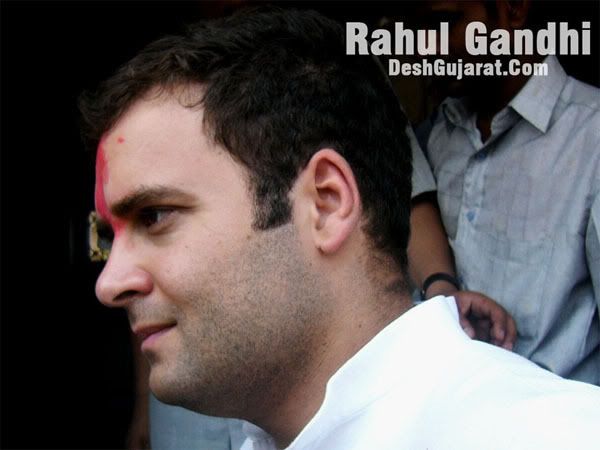
Rahul Gandhi, progeny of prime ministers, kicks off his campaign for India’s general election
30,000 people arise in Wardha, in the dead centre of India, and start waving at the sun-bleached sky. Rahul Gandhi—the 38-year-old heir to India’s great political dynasty; son, grandson and great-grandson of prime ministers; and leader in waiting of their Congress party—is coming.
30,000 people arise in Wardha, in the dead centre of India, and start waving at the sun-bleached sky. Rahul Gandhi—the 38-year-old heir to India’s great political dynasty; son, grandson and great-grandson of prime ministers; and leader in waiting of their Congress party—is coming.
On landing, in an ugly yellow dust-storm, Mr Gandhi climbs a small dais and, after some little-heeded words from Congress’s chief minister of Maharashtra, opens his campaign for the general election that is due to begin on April 16th. Speaking in a soft voice, and with deliberate, north-Indian-accented Hindi, he promises to fight poverty and for national unity. He makes bold claims for the outgoing Congress-led coalition government—especially for several welfare schemes that it has launched, including a massive debt write-off for small farmers. The crowd is hushed. In a desiccated cotton-growing region of Maharashtra, where rates of indebtedness and suicide among farmers are high, this was a popular measure.
Then “Jai Ho!”—the Oscar-winning theme-track to the film “Slumdog Millionaire”, which Congress has adopted for its campaign—blares through the speaker. And Mr Gandhi is up and off. Within 20 minutes, but for a few children combing for plastic water-bottles and other sellable rubbish, the rally-ground is empty.
This is a hopeful election for Congress, India’s closest approximation to a party with national appeal. Led by Mr Gandhi’s mother, Sonia Gandhi, and her chosen prime minister, Manmohan Singh, it has presided over a coalition government for the first time—and more skillfully than many expected. Coinciding with a run of unprecedentedly high economic growth, which provided bumper revenues for the open-handed schemes that Mr Gandhi boasted of, it also seems less unpopular than outgoing Indian governments often are. Because of this, and the weakness of its main opponent, the Hindu-nationalist Bharatiya Janata Party (BJP), Congress seems to have a decent chance of retaining power, at the helm of another coalition.
Buoyed by its success, the party that led India for three decades without a coalition is even dreaming it may one day do so again. Under Sonia Gandhi, who took over in 1998, seven years after her husband Rajiv was assassinated, it hopes to have arrested its long decline. At the last election, in 2004, it won 145 of India’s 543 parliamentary seats; in 1999 it won only 114. Under Rahul Gandhi, who lacks his mother’s handicap of foreign (Italian) birth, Congress plans to rebuild its eroded base.
It has therefore spurned possible electoral alliances in the populous northern states it once dominated, and which it must regain if it is to win a parliamentary majority. On March 21st Congress announced it would follow this strategy in Bihar, where it won just three of a possible 40 seats in 2004. This will mean fighting against two coalition allies, a party dedicated to low-caste Hindus and another to dalits, Hinduism’s former “untouchables”, that it will again want support from after the election. And on March 26th, the Samajwadi Party, which Congress had been negotiating a pact with in Uttar Pradesh (UP)—a state where it won 12 of 80 seats in 2004—said negotiations had failed because of Congress’s excessive demands.
This is a risky strategy, with Congress counting on winning enough seats to take the lead in forming a coalition, which its currently-piqued allies will then join. In the longer-term, it hopes that fighting alone in Bihar and UP will begin the process of rebuilding there, which Rahul Gandhi will lead. If Congress does retain power in the election, which will run until May 13th, many would expect him to take over as prime minister within a year or so from Mr Singh, who is 76 and frail.
Given that Congress stood to gain only a dozen or so extra seats from electoral tie-ups in UP and Bihar, its gamble looks reasonable. Fighting the election unencumbered will also give it a wider choice of allies after the poll, in which several of its erstwhile allies may fare poorly. For alternative—or additional—partners, Congress may have its eye on one or two current friends of the BJP. Underpinning its strategy, indeed, is a calculation that even if the Hindu nationalists win more seats than Congress in the election, they would be less able to build the necessary coalition.
Several former BJP allies—including the biggest prop of the former BJP-led government, Andhra Pradesh’s Telugu Desam Party—consider their association with the Hinduist party to have cost them crucial Muslim votes. And the BJP’s prime-ministerial candidate, L.K. Advani, is more divisive than his predecessor, Atal Behari Vajpayee. To reassure potential allies—and the many secular Indians who share its free-market agenda—the BJP is therefore trying to downplay its Hindu-chauvinist one. But this irks the party’s saffron-hued base.
A controversy stirred by Mr Gandhi’s estranged 29-year-old cousin, Varun Gandhi, who is standing in UP for the BJP, illustrates its dilemma. On March 16th a television news channel broadcast a recording of a speech in which Varun promised India’s 160m Muslims that he would “cut their throats after the election”. He has since been arrested and charged with attempted murder and other crimes. To appease the party’s livid stalwarts, Mr Advani has felt the need to back Varun’s claim to have been mis-recorded. He has also promised to campaign on Varun’s behalf. Meanwhile, an important BJP ally, Nitish Kumar, has said Varun must be prosecuted.
Congress’s more distant hope—for a national revival under Rahul Gandhi—looks dicey. Its Gandhi cult unites a party that would probably fracture without it, as happened after Rajiv Gandhi’s death. Yet Congress’s relentless shrinkage under Gandhi leadership—including in the last election, when its overall vote-share actually fell—is evidence of the family’s diminishing appeal. It will take more than a new Gandhi to woo many people back from regional and caste-based parties, which are more obviously devoted to dispensing the patronage poor Indians crave.
Mr Gandhi, who can seem an awkward politician, though he is clearly well-intentioned and no fool, knows this. In an interview in Delhi on March 30th, the day before he launched his campaign in Wardha, he was keen to discuss his ambitions—and fledgling efforts—to make Congress more democratic. His vision is a party in which “it doesn’t necessarily matter who your mother is or who your father is but how many supporters you have in the district.” That would be good, and may one day transpire. But if Congress wanted to be like that now, as Mr Gandhi must also know, he would not be about to inherit it.
Subscribe to:
Posts (Atom)

