Memebers of the public not only can stroll through the Istana grounds during the open house on this Labour Day they will also get to view a display of selected gifts presented by foreign dignitaries to the President and the Prime Minister.
For an entrance fee of $2, they can tour some of the function rooms in the Istana building to view the gifts, said a Government statement on Monday.
The Istana grounds will be open to the public on Friday from 8.30am to 6 pm.
Admission to the Istana grounds is free for Singaporeans and permanent residents. Others visitors will have to to pay $1 each to enter.
Entrance to the grounds is via the main gate at Orchard Road. Sale of tickets for the to the Istana building will close at 5.30pm.
Istana souvenirs will be sold during the Open House. Proceeds from the sale of souvenirs and all entrance fees collected will be donated to the Community Chest.
The Istana, spread over 100 acres of sprawling land, along bustling Orchard Road, is the official residence of President SR Nathan.
The Istana building was built by the British Colonial government to house its governors. Completed in 1869, it was then known as the Government House.
The building was handed over to the Singapore Government when the Republic attained internal self government in 1959, and renamed Istana ('Palace' in Malay).
The Istana building underwent extensive renovation between 1996 and 1998, to add more space and modern day conveniences. The building today has six function rooms used for ceremonies and to receive guests.
President Nathan will appear around 4pm in the evening...
For more information on the Istana, please visit http://www.istana.gov.sg
Wednesday, April 29, 2009

Friday, April 24, 2009
Thai Princess meets President Nathan
Thai Princess Maha Chakri Sirindhorn, the second daughter of King Bhumibol Adulyadej, is in Singapore on a five-day official visit.
On Thursday, she met Prime Minister Lee Hsien Loong at the Istana and was hosted to lunch by President S R Nathan.
At the Singapore Management University's (SMU) School of Accountancy, she was the guest of honour at the 3rd International Convention for Rehabilitation Engineering and Assistive Technology (i-CREATe) 2009 conference.
The conference was opened by the Community Development, Youth and Sports Minister Vivian Balakrishnan.
This year's theme - Accessible Tourism - promotes accessibility for all with the adoption of universal design, where assistive technologies will be used and introduced in the environment.
The event features workshops and forums, with over 20 speakers scheduled to touch on topics such as "Use of Technology for the Blind" and "Use of Technology for Rehabilitation".
On Thursday, she met Prime Minister Lee Hsien Loong at the Istana and was hosted to lunch by President S R Nathan.
At the Singapore Management University's (SMU) School of Accountancy, she was the guest of honour at the 3rd International Convention for Rehabilitation Engineering and Assistive Technology (i-CREATe) 2009 conference.
The conference was opened by the Community Development, Youth and Sports Minister Vivian Balakrishnan.
This year's theme - Accessible Tourism - promotes accessibility for all with the adoption of universal design, where assistive technologies will be used and introduced in the environment.
The event features workshops and forums, with over 20 speakers scheduled to touch on topics such as "Use of Technology for the Blind" and "Use of Technology for Rehabilitation".
Wednesday, April 22, 2009
President Nathan pays tribute to former PSC chairman Phay Seng Whatt
Besides his work at the PSC, Dr Phay also held various positions in the medical service, and was awarded the Distinguished Service Medal in 1963.
President Nathan said Dr Phay was among the band of illustrious Singaporeans who made valuable contributions to our society.
He added that "Dr Phay distinguished himself as someone diligent in the role he played in the fair selection of public servants at all levels of the service."
Mr Nathan said: "Finding good people with quality to man a public service is a critical and continuing problem. Assessing, selecting and evaluating people to fill critical key positions in the public service is even more critical. It calls for judging the worth of candidates and deciding whether one is better than another.
"Dr Phay developed experience over time to judge people and forecast their potential for higher responsibilities."
Dr Phay promoted several public servants to key positions, and President Nathan was among them.
President Nathan said Dr Phay was among the band of illustrious Singaporeans who made valuable contributions to our society.
He added that "Dr Phay distinguished himself as someone diligent in the role he played in the fair selection of public servants at all levels of the service."
Mr Nathan said: "Finding good people with quality to man a public service is a critical and continuing problem. Assessing, selecting and evaluating people to fill critical key positions in the public service is even more critical. It calls for judging the worth of candidates and deciding whether one is better than another.
"Dr Phay developed experience over time to judge people and forecast their potential for higher responsibilities."
Dr Phay promoted several public servants to key positions, and President Nathan was among them.
Sunday, April 19, 2009
PM celebrates Ah Neh New Year
Prime Minister Lee Hsien Loong asked Singaporeans to work at preserving the precious and harmonious multiracial society here, which is unique among nations.
This is especially important now in a recession, he said last night.
Celebrating the Tamil New Year with some 1,000 Indian residents of Ang Mo Kio GRC, he said many other countries find it difficult to manage ethnic relations.
This is especially important now in a recession, he said last night.
Celebrating the Tamil New Year with some 1,000 Indian residents of Ang Mo Kio GRC, he said many other countries find it difficult to manage ethnic relations.
Sunday, April 12, 2009
India: The world's most remarkable election
As the largest democracy on the planet prepares to elect a new government, and the choices facing the 714 million voters.
From the mountain heights of Kashmir to the palm-fringed beaches of Kerala, from Nagaland in the remote north-east to the Maharashtra heartland, India will this week throw itself headlong into the world's largest and most extraordinary election.
Here, in the planet's biggest, if imperfect, democracy, candidates from 1,055 parties will be seeking the support of more than 714 million registered voters – a number that has jumped by 40 million since the last election in 2004. Across India's 35 states and "union territories" there will be 800,000 polling stations ready to receive voters, while six million police will be on duty to try to maintain order. Such is the sheer scale of this enterprise that the voting is to be staggered over a month with five separate polling days. The result will be announced in mid-May.
Among some of the leading players in this political carnival are a movie star turned politician, whose rallies lure countless thousands of the poor, desperate for him to transform his on-screen Robin Hood heroism into real-life action; a "Dalit Queen", whose support among so-called Untouchables could carry her to the prime minister's official residence; a chief minister whose state saw a massacre of Muslims yet who has risen to become a potential leader of his party; and an elegant, Italian-born widow who holds the position as India's chief power broker. There are wealthy and poor, old and young, high-caste and low, nationalists and those who want to separate from India. There are those who preach peace, and those who promise violence. There are dozens of languages and many different scripts.
But if an Indian election provides a window in the extraordinary diversity of the subcontinent, it should not distract from the fundamental point that this is a contest for power. The centrist Congress Party, which heads the current ruling coalition, is battling to fight off a challenge not just from the main opposition, the right-wing Hindu nationalist Bharatiya Janata Party (BJP), but also from a third front of communist and left parties and even a fourth front that includes disgruntled former allies. Some analysts believe this election – the 15th since the country won independence in 1947 – is the most open in recent years.
What is clear is that the election is taking place against a backdrop of uncertainty and anxiety for India. While this emerging nation with its middle vision fixed on superpower status has not suffered the same sort of economic downturn as the West, many middle-class professions in the IT and software industry have for the first time faced redundancies and layoffs.
At the same time there is mounting concern about the threat of terrorism. Last year's Mumbai attacks saw more than 160 people killed by militants from Pakistan, and the issue of how to avoid a repeat of such incidents has dominated much public debate. India's relationship with Pakistan, which has never been warm, but which in recent years had been enjoying something of a thaw, has effectively now reverted to a stand-off. Meanwhile, the bodies of nine of the militants who carried out the attack – another man was captured alive – remain in a Mumbai mortuary waiting to be claimed.
"I will be voting BJP. The risk of terrorism is high and the Congress does not support a strict law against terrorism," said Praveen Rana, an Indian air force officer. "The problem for India is that 60 per cent of the population is poor and they vote in their own interests. The middle classes don't care about politics. That is why we only have bad politicians."
This criticism of politicians, particularly their alleged corruption, is a constant among supporters of all parties. In a country where bribery is embedded in everyday interactions – from getting a job or a canister of cooking gas to paying off a policeman – ordinary voters are disappointed but not surprised at reports of corruption. Indeed, Indian newspapers have been full of such stories. Just this week, police in the southern state of Andhra Pradesh, parts of which go to the polls on Thursday, uncovered wads of cash worth about £3m in a supposed "votes for notes" scandal. One regional watchdog claims £137m will be spent in the last few days of campaigning to pay for inducements. Many ordinary people believe instinctively that politicians are only interested in themselves.
"Nobody will help the poor. I have to work for my survival," said Krishaiah, a wizened flower-seller from the southern city of Hyderabad, touting strings of blooms alongside a noisy, traffic-filled road. "Neither the Congress nor anybody else can help."
That people have such distrust of politicians ought not to be a surprise. Of the 543 MPs returned to the Lok Sabha, or lower house of parliament, in 2004, a total of 128 had outstanding criminal charges against them. Of those alleged offences, 84 were for murder while other allegations included kidnapping, extortion and robbery. "[To be prevented from standing] the law requires a person to be convicted but a lot of these cases just drag on and on," said Anil Bairwal, coordinator of the Association for Democratic Reforms, a watchdog group that has collected these statistics. "By the time it comes to court, the person may have retired or passed on."
Leading the Congress's re-election campaign is party chairman Sonia Gandhi, the autocratic widow of assassinated former prime minister Rajiv Gandhi, and prime minister Manmohan Singh, a quiet, uncharismatic economist credited with kick-starting India's development but who has taken the country into a closer alignment with the US. Mrs Gandhi's quietly spoken 38-year-old son, Rahul, a great-grandson of India's first prime minister, Jawaharlal Nehru, is already a major presence in the party and is widely tipped as a future prime minister. The Congress, which bought the rights to the Slumdog Millionaire hit "Jai Ho" (Let There Be Victory) to use as its theme song, has sought to highlight the country's progress over the past five years.
Leading the BJP is the octogenarian L K Advani, a man who despite, or perhaps because of, his age has pitched himself as a politician of vitality and new ideas. He has even started blogging. Despite the ascension within the party's hierarchy of figures such Narendra Modi, a right-wing ideologue and chief minister of Gujarat, which in 2002 saw a massacre of Muslims, the BJP has tried to position itself towards the centre, arguing that it has moved away from its nationalist past.
But its dilemma of whether or not to give up the so-called Hindutva vote was underlined by the recent antics of Varun Gandhi, also a great-grandson of Nehru but the black sheep of the dynasty. Campaigning for the BJP in India's largest state, Uttar Pradesh, Mr Gandhi, who falsely claimed he had earned two degrees in London, vowed to cut off the heads of Muslims – an election promise that might have pleased Hindu extremists but which saw him thrown in jail and held under anti-terrorism laws.
Uttar Pradesh, which sends 80 MPs, was once a Congress stronghold but has since been controlled by two caste-based parties. The current chief minister, Mayawati, draws her support from Dalits and has gradually built her support elsewhere in the country. Brimming with ambition and with a penchant for commissioning super-sized statues of herself, the diminutive Mayawati has been tipped as a possible premier if she takes her Bahujan Samaj Party into an alliance with left parties in a third front.
In recent weeks, a fourth front has also emerged, made up of regional parties such as the Samajwadi Party, another caste-based party from Uttar Pradesh, and the Rashtriya Janata Dal from impoverished Bihar. While this grouping is unlikely to be able to form a government by itself, its fortunes have been boosted by the support of Konidela Shiva Shankara Vara Prasad, better known as Chiranjeevi, a popular Telugu-language movie star, who last year formed his own party in Andhra Pradesh. The larger-than-life actor has drawn huge crowds as his campaign tours the state. "Reforms need to take place," he said. "Rural areas have been neglected."
Pundits predict that whichever single party emerges with the most votes, it will be forced to make a coalition to form a government. This time around, there have been few pre-poll alliances with most parties opting to see how they stand in a month's time. "The real election will start on 16 May," said the veteran journalist and political analyst M J Akbar. "[The coalitions] are all marriages of convenience. There are no clear ideologies."
In a region where democracy has often struggled, it is perhaps a compliment to India's enduring civilian rule that few see radical changes, regardless of whichever of the major parties forms the next government. What the election does promise is terrific political theatre. Pull up a chair.
The India election in numbers
States
West Bengal: Bengal has been under Communist rule since gaining independence, and hammer and sickle flags jostle for space with images of Bollywood stars.
Kashmir: The most densely militarised place on Earth and still at the centre of South Asian tension.
Uttar Pradesh: India's largest and most important state, with a population of over 190 million. It is the electoral base of the Nehru-Gandhi dynasty, with Rahul and Sonia Gandhi both having constituencies here.
Gujarat: Fast becoming India's business hub, Gujarat is responsible for the production of about 90 per cent of India's required Soda Ash. It also provides about 66 per cent of all the salt used in India.
Kerala: A survey in 2005 ranked Kerala as the least corrupt state in the country. At 91 per cent, it also has the highest literacy rate in India.
Bihar: Nearly 85 per cent of Bihar's population is rural.
Haryana: At 29,887 rupees (£410), the state of Haryana has the third highest per capita income in India. It also has the largest number of rural crorepatis (similar to millionaires when taking into account the cost of living) in India.
Himachal Pradesh: In a 1981 census it was found that Hindus made up 95 per cent of the state population.
Maharashtra: Contributing to 15 per cent of India's industrial output and 13.2 per cent of its GDP in 2005-06, Maharashtra is the richest state in India.
Punjab: With just 6.16 per cent of the population living in poverty, Punjab is considered the least impoverished of India's states.
Nagaland: Over 85 per cent of the population of Nagaland are directly dependant on agriculture.
Orissa: Nearly half of the 38 million people living in Orissa are classed as living below the poverty line.
Tamil Nadu: More than 10 per cent of India's businesses are based in Tamil Nadu – the largest number for any state.
Sikkim: With only 540,000 inhabitants, Sikkim is India's least populous state. At 76 people per square kilometre, it also one of the least densely populated.
Mizoram: Christians make up 87 per cent of Mizoram's population – one of only three Indian states with a Christian majority.
Karnataka: With GDP growth of 56.2 per cent and per capita GDP growth of 43.9 per cent, Karnataka has been the fastest growing state over the past decade.
Arunachal Pradesh: The one million-strong population of Arunachal Pradesh is grouped into more than a hundred tribes and sub-tribes.
Manipur: A politically sensitive area, foreigners wishing to visit must get a permit which lasts up to ten days. Visitors are required to travel in groups of four on arranged tours with authorised agents only.
Chhattisgarh: Known as "the rice bowl of India", Chhattisgarh is one of the largest producers of rice in India – around 1.6 tonnes per hectare.
Assam: Separatist rebels and ethnic tension make this an unstable region, with attacks on migrants and 605 bomb blasts in the past eight years.
Madhya Pradesh: Sixty per cent of children aged under five are malnourished, leading to a mortality rate of one in 10 – among the world's worst areas for malnutrition.
Jharkhand: With a rapidly advancing economy, poverty declined by 2 per cent per year between 1994 and 2002.
Goa: Hundreds of thousands of tourists flock here each year attracted by Goa's beaches and world heritage architecture.
Rajasthan: The largest state in India, Rajasthan has an area of 342,269km2, around 100,000km2 more than the UK.
Andhra Pradesh: At 972km, Andhra Pradesh has the second largest coastline in India.
Meghalaya: The population is mostly composed of tribespeople, 70 per cent of them Christian owing to the work of early missionaries.
Tripura: A state ruled by members of the Left Front, including the Communist Party of India (Marxist) and the Revolutionary Socialist Party.
Uttarakhand: The capital, Dehradun, is sometimes known as "the Oxford of India" for its wide array of boarding schools.
Union territories
Chandigarh: The city of Chandigarh has the highest per capita income in the country at 99,262 rupees (£1,350). It is also a union territory.
Andaman and Nicobar Islands: The islands were struck by the 2004 Boxing Day tsunami; 2,500 people were killed and 5,000 pronounced missing.
Lakshadweep: India's smallest union territory with a population of just 60,650.
Delhi: Current estimates put the municipal population at 17 million, making Delhi the sixth most populous city in the world.
Puducherry: With colleges for engineering, the arts, sciences, medicine and technology, Puducherry is considered an educational centre for southern India.
Dadra and Nagar Haveli: These Portuguese colonies were liberated in July 1954, and an agreement signed in 1961 to merge them with the rest of India.
Daman and Diu: With a population of just 158,204 , this is India's second least populous area.
General election facts
There are 543 seats in the Lok Sabha, the directly elected lower house which is also known as the House of the People. Elections take place every five years.
There are 730 million registered voters in India, an increase of 40 million since 2004.
Voting will be conducted at 800,000 polling booths and 1,368,430 electronic voting machines.
More than two million security personnel will be on hand to ensure the elections run without a hitch.
Of the candidates announced so far, at least 70 have criminal cases pending against them. The charges include murder, rape, kidnapping, extortion and assault.
Voting takes place over five phases between 16 April and 13 May.
India's biggest political party, the Indian National Congress, is part of the United Progressive Alliance which brings together parties willing to support a Congress-led national government.
The main opposition, the Bharatiya Jarata Party (BJP), is part of the National Democratic Alliance. This coalition was the first to be forged between a major national party and a range of regional players.
The Third Front, a leftist grouping, re-named itself the United National Progressive Alliance last month. The UNPA lists the Communist Party of India, the Forward Bloc and the Revolutionary Socialist Party among its 10 members.
From the mountain heights of Kashmir to the palm-fringed beaches of Kerala, from Nagaland in the remote north-east to the Maharashtra heartland, India will this week throw itself headlong into the world's largest and most extraordinary election.
Here, in the planet's biggest, if imperfect, democracy, candidates from 1,055 parties will be seeking the support of more than 714 million registered voters – a number that has jumped by 40 million since the last election in 2004. Across India's 35 states and "union territories" there will be 800,000 polling stations ready to receive voters, while six million police will be on duty to try to maintain order. Such is the sheer scale of this enterprise that the voting is to be staggered over a month with five separate polling days. The result will be announced in mid-May.
Among some of the leading players in this political carnival are a movie star turned politician, whose rallies lure countless thousands of the poor, desperate for him to transform his on-screen Robin Hood heroism into real-life action; a "Dalit Queen", whose support among so-called Untouchables could carry her to the prime minister's official residence; a chief minister whose state saw a massacre of Muslims yet who has risen to become a potential leader of his party; and an elegant, Italian-born widow who holds the position as India's chief power broker. There are wealthy and poor, old and young, high-caste and low, nationalists and those who want to separate from India. There are those who preach peace, and those who promise violence. There are dozens of languages and many different scripts.
But if an Indian election provides a window in the extraordinary diversity of the subcontinent, it should not distract from the fundamental point that this is a contest for power. The centrist Congress Party, which heads the current ruling coalition, is battling to fight off a challenge not just from the main opposition, the right-wing Hindu nationalist Bharatiya Janata Party (BJP), but also from a third front of communist and left parties and even a fourth front that includes disgruntled former allies. Some analysts believe this election – the 15th since the country won independence in 1947 – is the most open in recent years.
What is clear is that the election is taking place against a backdrop of uncertainty and anxiety for India. While this emerging nation with its middle vision fixed on superpower status has not suffered the same sort of economic downturn as the West, many middle-class professions in the IT and software industry have for the first time faced redundancies and layoffs.
At the same time there is mounting concern about the threat of terrorism. Last year's Mumbai attacks saw more than 160 people killed by militants from Pakistan, and the issue of how to avoid a repeat of such incidents has dominated much public debate. India's relationship with Pakistan, which has never been warm, but which in recent years had been enjoying something of a thaw, has effectively now reverted to a stand-off. Meanwhile, the bodies of nine of the militants who carried out the attack – another man was captured alive – remain in a Mumbai mortuary waiting to be claimed.
"I will be voting BJP. The risk of terrorism is high and the Congress does not support a strict law against terrorism," said Praveen Rana, an Indian air force officer. "The problem for India is that 60 per cent of the population is poor and they vote in their own interests. The middle classes don't care about politics. That is why we only have bad politicians."
This criticism of politicians, particularly their alleged corruption, is a constant among supporters of all parties. In a country where bribery is embedded in everyday interactions – from getting a job or a canister of cooking gas to paying off a policeman – ordinary voters are disappointed but not surprised at reports of corruption. Indeed, Indian newspapers have been full of such stories. Just this week, police in the southern state of Andhra Pradesh, parts of which go to the polls on Thursday, uncovered wads of cash worth about £3m in a supposed "votes for notes" scandal. One regional watchdog claims £137m will be spent in the last few days of campaigning to pay for inducements. Many ordinary people believe instinctively that politicians are only interested in themselves.
"Nobody will help the poor. I have to work for my survival," said Krishaiah, a wizened flower-seller from the southern city of Hyderabad, touting strings of blooms alongside a noisy, traffic-filled road. "Neither the Congress nor anybody else can help."
That people have such distrust of politicians ought not to be a surprise. Of the 543 MPs returned to the Lok Sabha, or lower house of parliament, in 2004, a total of 128 had outstanding criminal charges against them. Of those alleged offences, 84 were for murder while other allegations included kidnapping, extortion and robbery. "[To be prevented from standing] the law requires a person to be convicted but a lot of these cases just drag on and on," said Anil Bairwal, coordinator of the Association for Democratic Reforms, a watchdog group that has collected these statistics. "By the time it comes to court, the person may have retired or passed on."
Leading the Congress's re-election campaign is party chairman Sonia Gandhi, the autocratic widow of assassinated former prime minister Rajiv Gandhi, and prime minister Manmohan Singh, a quiet, uncharismatic economist credited with kick-starting India's development but who has taken the country into a closer alignment with the US. Mrs Gandhi's quietly spoken 38-year-old son, Rahul, a great-grandson of India's first prime minister, Jawaharlal Nehru, is already a major presence in the party and is widely tipped as a future prime minister. The Congress, which bought the rights to the Slumdog Millionaire hit "Jai Ho" (Let There Be Victory) to use as its theme song, has sought to highlight the country's progress over the past five years.
Leading the BJP is the octogenarian L K Advani, a man who despite, or perhaps because of, his age has pitched himself as a politician of vitality and new ideas. He has even started blogging. Despite the ascension within the party's hierarchy of figures such Narendra Modi, a right-wing ideologue and chief minister of Gujarat, which in 2002 saw a massacre of Muslims, the BJP has tried to position itself towards the centre, arguing that it has moved away from its nationalist past.
But its dilemma of whether or not to give up the so-called Hindutva vote was underlined by the recent antics of Varun Gandhi, also a great-grandson of Nehru but the black sheep of the dynasty. Campaigning for the BJP in India's largest state, Uttar Pradesh, Mr Gandhi, who falsely claimed he had earned two degrees in London, vowed to cut off the heads of Muslims – an election promise that might have pleased Hindu extremists but which saw him thrown in jail and held under anti-terrorism laws.
Uttar Pradesh, which sends 80 MPs, was once a Congress stronghold but has since been controlled by two caste-based parties. The current chief minister, Mayawati, draws her support from Dalits and has gradually built her support elsewhere in the country. Brimming with ambition and with a penchant for commissioning super-sized statues of herself, the diminutive Mayawati has been tipped as a possible premier if she takes her Bahujan Samaj Party into an alliance with left parties in a third front.
In recent weeks, a fourth front has also emerged, made up of regional parties such as the Samajwadi Party, another caste-based party from Uttar Pradesh, and the Rashtriya Janata Dal from impoverished Bihar. While this grouping is unlikely to be able to form a government by itself, its fortunes have been boosted by the support of Konidela Shiva Shankara Vara Prasad, better known as Chiranjeevi, a popular Telugu-language movie star, who last year formed his own party in Andhra Pradesh. The larger-than-life actor has drawn huge crowds as his campaign tours the state. "Reforms need to take place," he said. "Rural areas have been neglected."
Pundits predict that whichever single party emerges with the most votes, it will be forced to make a coalition to form a government. This time around, there have been few pre-poll alliances with most parties opting to see how they stand in a month's time. "The real election will start on 16 May," said the veteran journalist and political analyst M J Akbar. "[The coalitions] are all marriages of convenience. There are no clear ideologies."
In a region where democracy has often struggled, it is perhaps a compliment to India's enduring civilian rule that few see radical changes, regardless of whichever of the major parties forms the next government. What the election does promise is terrific political theatre. Pull up a chair.
The India election in numbers
States
West Bengal: Bengal has been under Communist rule since gaining independence, and hammer and sickle flags jostle for space with images of Bollywood stars.
Kashmir: The most densely militarised place on Earth and still at the centre of South Asian tension.
Uttar Pradesh: India's largest and most important state, with a population of over 190 million. It is the electoral base of the Nehru-Gandhi dynasty, with Rahul and Sonia Gandhi both having constituencies here.
Gujarat: Fast becoming India's business hub, Gujarat is responsible for the production of about 90 per cent of India's required Soda Ash. It also provides about 66 per cent of all the salt used in India.
Kerala: A survey in 2005 ranked Kerala as the least corrupt state in the country. At 91 per cent, it also has the highest literacy rate in India.
Bihar: Nearly 85 per cent of Bihar's population is rural.
Haryana: At 29,887 rupees (£410), the state of Haryana has the third highest per capita income in India. It also has the largest number of rural crorepatis (similar to millionaires when taking into account the cost of living) in India.
Himachal Pradesh: In a 1981 census it was found that Hindus made up 95 per cent of the state population.
Maharashtra: Contributing to 15 per cent of India's industrial output and 13.2 per cent of its GDP in 2005-06, Maharashtra is the richest state in India.
Punjab: With just 6.16 per cent of the population living in poverty, Punjab is considered the least impoverished of India's states.
Nagaland: Over 85 per cent of the population of Nagaland are directly dependant on agriculture.
Orissa: Nearly half of the 38 million people living in Orissa are classed as living below the poverty line.
Tamil Nadu: More than 10 per cent of India's businesses are based in Tamil Nadu – the largest number for any state.
Sikkim: With only 540,000 inhabitants, Sikkim is India's least populous state. At 76 people per square kilometre, it also one of the least densely populated.
Mizoram: Christians make up 87 per cent of Mizoram's population – one of only three Indian states with a Christian majority.
Karnataka: With GDP growth of 56.2 per cent and per capita GDP growth of 43.9 per cent, Karnataka has been the fastest growing state over the past decade.
Arunachal Pradesh: The one million-strong population of Arunachal Pradesh is grouped into more than a hundred tribes and sub-tribes.
Manipur: A politically sensitive area, foreigners wishing to visit must get a permit which lasts up to ten days. Visitors are required to travel in groups of four on arranged tours with authorised agents only.
Chhattisgarh: Known as "the rice bowl of India", Chhattisgarh is one of the largest producers of rice in India – around 1.6 tonnes per hectare.
Assam: Separatist rebels and ethnic tension make this an unstable region, with attacks on migrants and 605 bomb blasts in the past eight years.
Madhya Pradesh: Sixty per cent of children aged under five are malnourished, leading to a mortality rate of one in 10 – among the world's worst areas for malnutrition.
Jharkhand: With a rapidly advancing economy, poverty declined by 2 per cent per year between 1994 and 2002.
Goa: Hundreds of thousands of tourists flock here each year attracted by Goa's beaches and world heritage architecture.
Rajasthan: The largest state in India, Rajasthan has an area of 342,269km2, around 100,000km2 more than the UK.
Andhra Pradesh: At 972km, Andhra Pradesh has the second largest coastline in India.
Meghalaya: The population is mostly composed of tribespeople, 70 per cent of them Christian owing to the work of early missionaries.
Tripura: A state ruled by members of the Left Front, including the Communist Party of India (Marxist) and the Revolutionary Socialist Party.
Uttarakhand: The capital, Dehradun, is sometimes known as "the Oxford of India" for its wide array of boarding schools.
Union territories
Chandigarh: The city of Chandigarh has the highest per capita income in the country at 99,262 rupees (£1,350). It is also a union territory.
Andaman and Nicobar Islands: The islands were struck by the 2004 Boxing Day tsunami; 2,500 people were killed and 5,000 pronounced missing.
Lakshadweep: India's smallest union territory with a population of just 60,650.
Delhi: Current estimates put the municipal population at 17 million, making Delhi the sixth most populous city in the world.
Puducherry: With colleges for engineering, the arts, sciences, medicine and technology, Puducherry is considered an educational centre for southern India.
Dadra and Nagar Haveli: These Portuguese colonies were liberated in July 1954, and an agreement signed in 1961 to merge them with the rest of India.
Daman and Diu: With a population of just 158,204 , this is India's second least populous area.
General election facts
There are 543 seats in the Lok Sabha, the directly elected lower house which is also known as the House of the People. Elections take place every five years.
There are 730 million registered voters in India, an increase of 40 million since 2004.
Voting will be conducted at 800,000 polling booths and 1,368,430 electronic voting machines.
More than two million security personnel will be on hand to ensure the elections run without a hitch.
Of the candidates announced so far, at least 70 have criminal cases pending against them. The charges include murder, rape, kidnapping, extortion and assault.
Voting takes place over five phases between 16 April and 13 May.
India's biggest political party, the Indian National Congress, is part of the United Progressive Alliance which brings together parties willing to support a Congress-led national government.
The main opposition, the Bharatiya Jarata Party (BJP), is part of the National Democratic Alliance. This coalition was the first to be forged between a major national party and a range of regional players.
The Third Front, a leftist grouping, re-named itself the United National Progressive Alliance last month. The UNPA lists the Communist Party of India, the Forward Bloc and the Revolutionary Socialist Party among its 10 members.
Saturday, April 11, 2009
Indian Rojak Saga

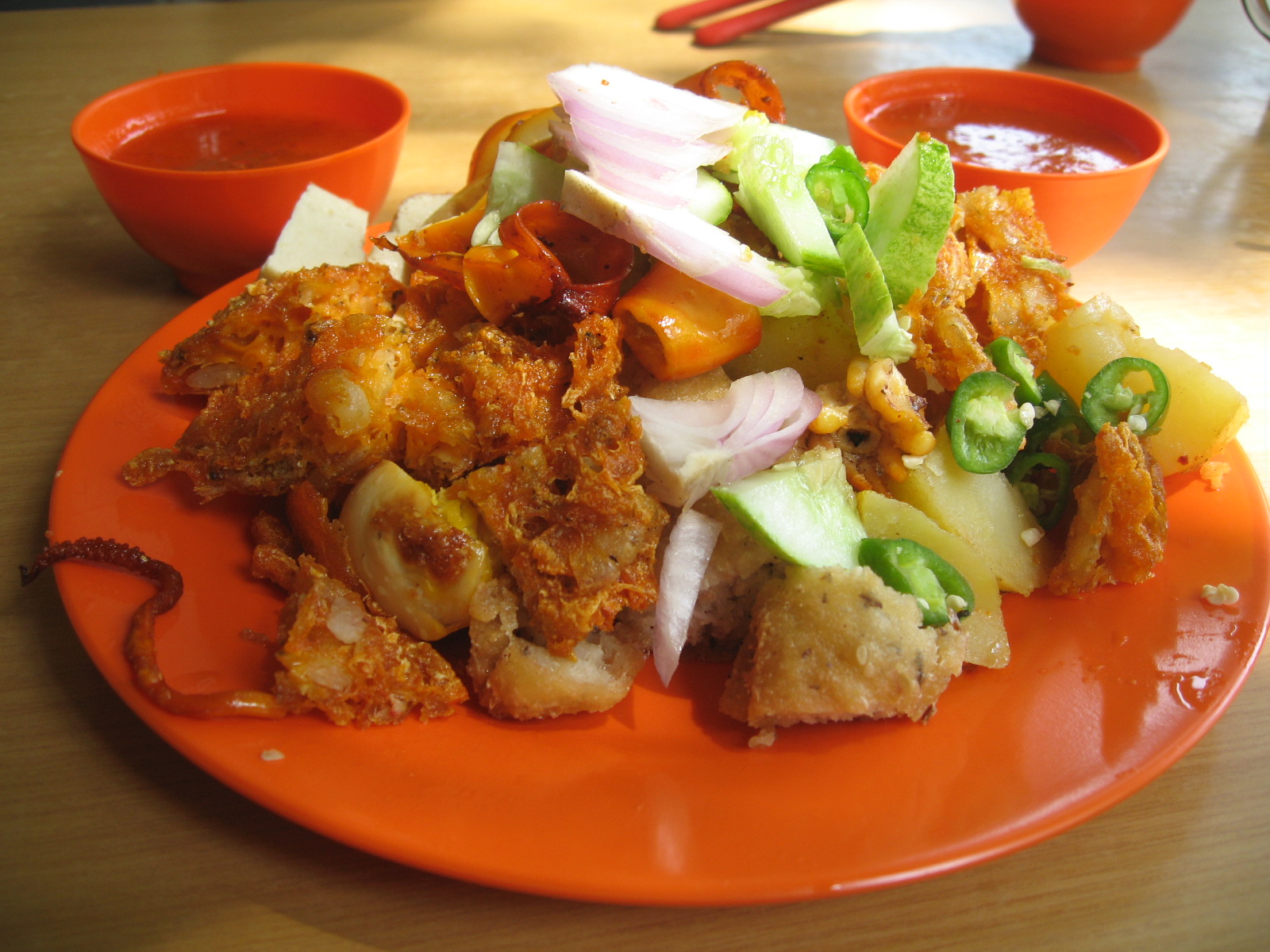
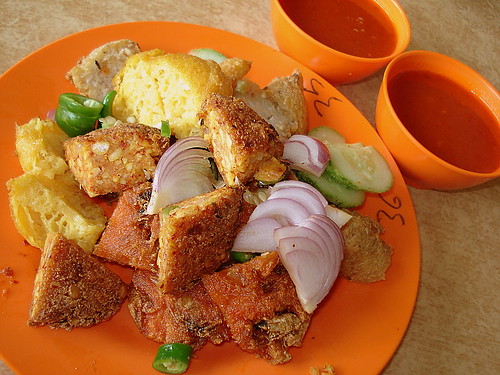
Two women dead, another in coma and one had a miscarriage while more than 130 others fell ill as a result of the food poisoning from an Indian rojak stall in Geylang Serai. Here are all the stories on the case.
Singapore, April 6, 2009 - One woman has died after falling into a coma. She was among the more than 100 people who ate Indian rojak from a famous stall in Geylang Serai and suffered food poisoning.
Canteen assistant Aminah Samijo, 57, fell unconscious at home on Friday night. Earlier in the afternoon, she and her husband, Mr Ali, had patronised the rojak stall. The couple vomitted and had diarrhoea that night but Madam Haminah's condition got worse - she fainted at 11pm.
Her family called an ambulance which sent her to Changi Hospital. While Mr Ali's condition was stable, his wife developed a fever on Saturday. Her condition worsened and she died this morning at around 6.30am at Changi hospital.
Her body was moved to Singapore General Hospital for autopsy. Food poisoning could cause organ failure and death, and eldely patients are more prone to that.
Madam Aminah had kidney problems and low blood pressure before the incident.
The rojak stall, operated by a father and son team, had been shut following the food poisoning incident. Known as Rojak Geylang Serai, the stall had received a 'recommended' rating of two and a half chopsticks out of three by famous food guide Makansutra.
Those who fell sick sought treatment at the six major hospitals in Singapore and had said they had eaten rojak from the Geylang Serai stall.
By 5pm on Saturday, 75 of the victims had sought treatment at Changi Hospital. Seventeen of them were warded.
Tan Tock Seng, KK and NUH hospitals received 10, seven and nine patients respectively. Seven at Tan Tock Seng were warded while five had to remain at KK Hospital.
Singapore General and Alexandra hospitals had one patient each.
It is believed there were many more who had eaten rojak bought from the same stall.
The incident is believed to be the worst mass food poisoning case to hit Singapore since 2007. That year, more than 150 got sick after eating Prima Deli products.
Lorry driver, 4 children warded
Another victim, lorry driver Mr Abdul, 44, and his family also ate at the same stall though at different times. He and his wife and four children also fell sick. All of them accompanied him to Changi hospital but as the children became ill, three of them were sent to KK Hospital because of their young age while one was admitted to Changi hospital.
Mr Abdul's wife, Rohanna, who still suffered the effects of food poisoning, had no choice but to shuttle between the two hospitals to see that her children and husband were all right.
Mr Abdul had patronised the rojak stall with a friend during lunch time on Friday. His wife took their kids to the stall later that afternoon. It was their favourite Indian rojak stall.
On Saturday, the rojak stall had already prepared food for sale but had to dispose them when NEA and Health ministry officers came to inspect the stall. Both authorities are investigating. The stallholder and a worker were told to go for screening at the Communicable Disease Centre.
One stallholder said NEA officers also inspected every stall.
Singapore, April 6, 2009 - A TWO-MONTH pregnant woman who had eaten rojak bought from the same stall in Geylang Serai market, came down with severe diarrhoea on Friday evening and later suffered a miscarriage.
Madam Rosiah Samat, 38, suffered acute pains in her stomach and was shuttling to the toilet at least six times before she started to bleed profusely. 'It was pain like nothing else I felt before,' she told The Straits Times in Malay on Monday. 'I thought I was going to die. I could hear my children yelling 'Wake up, mummy! Wake up!' as I was falling unconscious. I told them to quickly call for the ambulance.'
Her 12-year-old daughter, Haidah Wahid, said that Madam Rosiah was covered in sweat and she was shivering all over. Shortly after, she fainted and was rushed to the KK Women's and Children's hospital where she was later told that she had suffered a miscarriage.
More on Indian Rojak
Singapore, April 8, 2009 - Another woman has died in the Indian rojak food poisoning.
She is Madam Noraini Kasim, who went into a coma after eating rojak bought Rojak Geylang Serai. Madam Noraini, 59, died this morning, five days after she was warded in Alexandra Hospital's intensive care unit.
According to her husband, Mr Mohd Salleh Sapir, she had a history of diabetes.
But the hygiene standards at Rojak Geylang Serai were deemed satisfactory in December last year - it scored a 'C' grading when National Environment Agency (NEA) officials conducted a check. Four months later, 137 patrons suffered food poisoning - one has died and another is still in a coma.
A spokesman for the agency said stalls with 'C' or 'D' grading are inspected more frequently than those with 'A' and 'B' grading. Grades are reviewed every year by environmental health officers. During inspections, hygiene irregularities are pointed out and stallholders have the responsibility to correct them.
The NEA said the hygiene standards of stalls at the Geylang Serai temporary market remain satisfactory, but it will continue to keep a close watch.
Meanwhile, the outbreak of food poisoning among those who ate Indian rojak at a Geylang Serai temporary hawker centre has worsened, with the Ministry of Health (MOH) raising the number of those who fell ill to 137, up from 111.
Of these, 37 have been warded in hospital, while the rest were given outpatient treatment. Among the 37 warded were one woman who has died, and one who is in a coma.
Tests show two victims had bacteria common in partially cooked seafood The Geylang Serai Temporary Market has been shut down from today till Friday.
Friday, April 10, 2009
Prataman's Challenge

Nathan urges all S'poreans to help needy families in the downturn.
PRESIDENT SR Nathan has set a fund-raising target of $8 million for this year's President's Challenge. Speaking at the official launch of the 2009 President's Challenge, held last night at the Singapore Flyer, the President said: 'We must focus on helping needy families who are even more vulnerable in this downturn.'
He urged all Singaporeans to play their part, noting that about 20 organisations have already pledged to support the charity.
The President's Challenge, which celebrates its 10th anniversary this year, is an annual charity drive featuring a series of community-based events and activities.
Since its inception, more than $70 million has been raised for about 400 beneficiaries, with the help of organisations such as the Singapore Totalisator Board and Singapore Pools. More than $12 million was raised in last year's event.
This year, more than 260,000 people are expected to take part in various events over the next several months such as the President's Star Charity show, which is slated for October.
Last night's launch, which featured live music and entertainment as well as a spectacular fireworks display over Marina Bay, was held in conjunction with the Flyer's first anniversary celebrations.
During the ceremony, which saw 250 invited guests, President Nathan launched a set of 10th-anniversary commemorative stamps.
Also, the Singapore Flyer unveiled a donation bank to be placed at the attraction from now until Dec 31 to raise funds for this year's President Challenge. The Flyer also made an initial contribution of $10,000 to the challenge.
Mr Nathan expressed hope that Singaporeans will extend kindness and cheer to all the charity's beneficiaries.
'Every contribution helps, be it a monetary donation or the giving of time,' he said.
The public may contribute by donating online at http://www.pc.org.sg/
They can also raise public awareness for the cause by signing up at the President's Challenge Cause page, found on social networking site Facebook.
Why don't you start by giving up your Million $$$ salary?!
Thursday, April 09, 2009
Politics runs in Indian blood
JBJ's son Kenneth joins Reform Party
Opposition party member open to contesting next GE
MR KENNETH Jeyaretnam, the elder son of late opposition leader J.B. Jeyaretnam, has joined the opposition ranks and is not ruling out contesting the next general election.
Three weeks ago, he joined the Reform Party, which was set up by his father a few months before he died last September.
The 50-year-old hedge fund manager was co-opted into the party's 13-man central executive committee (CEC) a week later.
Mr Jeyaretnam confirmed to The Straits Times yesterday that he had joined the opposition party. 'The timing was right. My father founded the party, so this is one way to honour him and to continue his legacy,' he said.
The party was set up by the late Mr Jeyaretnam - better known as JBJ - after he was discharged from bankruptcy in 2007. It was registered last July.
But he died of heart failure two months later. He was 82.
There has been speculation on the opposition scene in recent months that the younger Jeyaretnam would be entering the fray. This was in the light of speeches he made at events organised by opposition parties in memory of his father.
Mr Jeyaretnam said he had recently thought about entering politics, after Reform Party CEC member James Teo invited him to join the party. He next met Mr Ng Teck Siong, the party chairman and his father's long-time ally, and made his decision.
Married with a 12-year-old son, Mr Jeyaretnam worked in London's financial sector for several years before he returned with his family to Singapore last April.
His brother Philip, 45, is a Senior Counsel and partner at Rodyk & Davidson, and a former president of the Law Society.
The brothers graduated from Cambridge University with first-class honours degrees in economics and law respectively.
Asked if his brother would join politics too, Mr Jeyaretnam said: 'My brother is his own man. You would have to ask him.'
Mr Philip Jeyaretnam could not be reached for comment.
Mr Ng said the Reform Party plans to tap Mr Jeyaretnam's economics expertise, and might also field him at the next polls.
'As a party, we will try to get the best people to run for elections. Kenneth is a potential candidate,' he said.
Mr Jeyaretnam said he is open to standing as a candidate, and he sees a need for a 'real economist' on the political scene, to raise economic issues.
He added: 'Like the Prime Minister, I also have a double first from Cambridge.'
PM Lee Hsien Loong, 57, earned double first-class honours in mathematics at Cambridge.
Is Mr Jeyaretnam a potential successor to his father's secretary-general post in the Reform Party? 'The CEC will have to decide on that,' Mr Ng replied.
That post has been left vacant since Mr J.B. Jeyaretnam's death. Other vacant posts are those of assistant secretary-general and treasurer, added Mr Ng.
The party has recruited 20 members since October. Among them is Mr Ng E-Jay, 32, a blogger who is doing a doctorate in mathematics at the National University of Singapore.
Political observer Eugene Tan, a law lecturer at Singapore Management University, said Mr Jeyaretnam has given the Reform Party a 'tremendous boost', given his academic achievements, professional background and political pedigree.
Meanwhile, the party that the late Mr Jeyaretnam used to lead, the Workers' Party, has also seen changes in its membership, but in the form of resignations. Four members have quit in the past two weeks.
They include Mr Abdul Salim Harun, 27, and Ms Lee Wai Leng, 30, who were part of the Workers' Party team that lost to PM Lee's team in Ang Mo Kio GRC during the 2006 polls.
The party's organising secretary, Mr Yaw Shin Leong, who led the Ang Mo Kio team, said: 'In all organisations, members come and go. They have contributed to the party. We wish them well.'
Get ready for the Dark force or black Horse.
Opposition party member open to contesting next GE
MR KENNETH Jeyaretnam, the elder son of late opposition leader J.B. Jeyaretnam, has joined the opposition ranks and is not ruling out contesting the next general election.
Three weeks ago, he joined the Reform Party, which was set up by his father a few months before he died last September.
The 50-year-old hedge fund manager was co-opted into the party's 13-man central executive committee (CEC) a week later.
Mr Jeyaretnam confirmed to The Straits Times yesterday that he had joined the opposition party. 'The timing was right. My father founded the party, so this is one way to honour him and to continue his legacy,' he said.
The party was set up by the late Mr Jeyaretnam - better known as JBJ - after he was discharged from bankruptcy in 2007. It was registered last July.
But he died of heart failure two months later. He was 82.
There has been speculation on the opposition scene in recent months that the younger Jeyaretnam would be entering the fray. This was in the light of speeches he made at events organised by opposition parties in memory of his father.
Mr Jeyaretnam said he had recently thought about entering politics, after Reform Party CEC member James Teo invited him to join the party. He next met Mr Ng Teck Siong, the party chairman and his father's long-time ally, and made his decision.
Married with a 12-year-old son, Mr Jeyaretnam worked in London's financial sector for several years before he returned with his family to Singapore last April.
His brother Philip, 45, is a Senior Counsel and partner at Rodyk & Davidson, and a former president of the Law Society.
The brothers graduated from Cambridge University with first-class honours degrees in economics and law respectively.
Asked if his brother would join politics too, Mr Jeyaretnam said: 'My brother is his own man. You would have to ask him.'
Mr Philip Jeyaretnam could not be reached for comment.
Mr Ng said the Reform Party plans to tap Mr Jeyaretnam's economics expertise, and might also field him at the next polls.
'As a party, we will try to get the best people to run for elections. Kenneth is a potential candidate,' he said.
Mr Jeyaretnam said he is open to standing as a candidate, and he sees a need for a 'real economist' on the political scene, to raise economic issues.
He added: 'Like the Prime Minister, I also have a double first from Cambridge.'
PM Lee Hsien Loong, 57, earned double first-class honours in mathematics at Cambridge.
Is Mr Jeyaretnam a potential successor to his father's secretary-general post in the Reform Party? 'The CEC will have to decide on that,' Mr Ng replied.
That post has been left vacant since Mr J.B. Jeyaretnam's death. Other vacant posts are those of assistant secretary-general and treasurer, added Mr Ng.
The party has recruited 20 members since October. Among them is Mr Ng E-Jay, 32, a blogger who is doing a doctorate in mathematics at the National University of Singapore.
Political observer Eugene Tan, a law lecturer at Singapore Management University, said Mr Jeyaretnam has given the Reform Party a 'tremendous boost', given his academic achievements, professional background and political pedigree.
Meanwhile, the party that the late Mr Jeyaretnam used to lead, the Workers' Party, has also seen changes in its membership, but in the form of resignations. Four members have quit in the past two weeks.
They include Mr Abdul Salim Harun, 27, and Ms Lee Wai Leng, 30, who were part of the Workers' Party team that lost to PM Lee's team in Ang Mo Kio GRC during the 2006 polls.
The party's organising secretary, Mr Yaw Shin Leong, who led the Ang Mo Kio team, said: 'In all organisations, members come and go. They have contributed to the party. We wish them well.'
Get ready for the Dark force or black Horse.
Tuesday, April 07, 2009
Friday, April 03, 2009
There is still a Gandhi left for India's Election
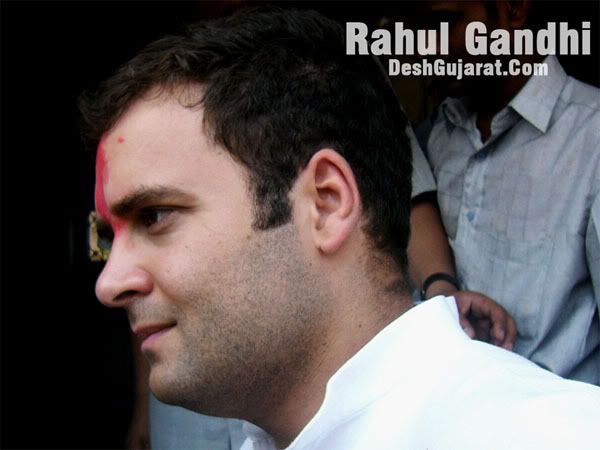
Rahul Gandhi, progeny of prime ministers, kicks off his campaign for India’s general election
30,000 people arise in Wardha, in the dead centre of India, and start waving at the sun-bleached sky. Rahul Gandhi—the 38-year-old heir to India’s great political dynasty; son, grandson and great-grandson of prime ministers; and leader in waiting of their Congress party—is coming.
30,000 people arise in Wardha, in the dead centre of India, and start waving at the sun-bleached sky. Rahul Gandhi—the 38-year-old heir to India’s great political dynasty; son, grandson and great-grandson of prime ministers; and leader in waiting of their Congress party—is coming.
On landing, in an ugly yellow dust-storm, Mr Gandhi climbs a small dais and, after some little-heeded words from Congress’s chief minister of Maharashtra, opens his campaign for the general election that is due to begin on April 16th. Speaking in a soft voice, and with deliberate, north-Indian-accented Hindi, he promises to fight poverty and for national unity. He makes bold claims for the outgoing Congress-led coalition government—especially for several welfare schemes that it has launched, including a massive debt write-off for small farmers. The crowd is hushed. In a desiccated cotton-growing region of Maharashtra, where rates of indebtedness and suicide among farmers are high, this was a popular measure.
Then “Jai Ho!”—the Oscar-winning theme-track to the film “Slumdog Millionaire”, which Congress has adopted for its campaign—blares through the speaker. And Mr Gandhi is up and off. Within 20 minutes, but for a few children combing for plastic water-bottles and other sellable rubbish, the rally-ground is empty.
This is a hopeful election for Congress, India’s closest approximation to a party with national appeal. Led by Mr Gandhi’s mother, Sonia Gandhi, and her chosen prime minister, Manmohan Singh, it has presided over a coalition government for the first time—and more skillfully than many expected. Coinciding with a run of unprecedentedly high economic growth, which provided bumper revenues for the open-handed schemes that Mr Gandhi boasted of, it also seems less unpopular than outgoing Indian governments often are. Because of this, and the weakness of its main opponent, the Hindu-nationalist Bharatiya Janata Party (BJP), Congress seems to have a decent chance of retaining power, at the helm of another coalition.
Buoyed by its success, the party that led India for three decades without a coalition is even dreaming it may one day do so again. Under Sonia Gandhi, who took over in 1998, seven years after her husband Rajiv was assassinated, it hopes to have arrested its long decline. At the last election, in 2004, it won 145 of India’s 543 parliamentary seats; in 1999 it won only 114. Under Rahul Gandhi, who lacks his mother’s handicap of foreign (Italian) birth, Congress plans to rebuild its eroded base.
It has therefore spurned possible electoral alliances in the populous northern states it once dominated, and which it must regain if it is to win a parliamentary majority. On March 21st Congress announced it would follow this strategy in Bihar, where it won just three of a possible 40 seats in 2004. This will mean fighting against two coalition allies, a party dedicated to low-caste Hindus and another to dalits, Hinduism’s former “untouchables”, that it will again want support from after the election. And on March 26th, the Samajwadi Party, which Congress had been negotiating a pact with in Uttar Pradesh (UP)—a state where it won 12 of 80 seats in 2004—said negotiations had failed because of Congress’s excessive demands.
This is a risky strategy, with Congress counting on winning enough seats to take the lead in forming a coalition, which its currently-piqued allies will then join. In the longer-term, it hopes that fighting alone in Bihar and UP will begin the process of rebuilding there, which Rahul Gandhi will lead. If Congress does retain power in the election, which will run until May 13th, many would expect him to take over as prime minister within a year or so from Mr Singh, who is 76 and frail.
Given that Congress stood to gain only a dozen or so extra seats from electoral tie-ups in UP and Bihar, its gamble looks reasonable. Fighting the election unencumbered will also give it a wider choice of allies after the poll, in which several of its erstwhile allies may fare poorly. For alternative—or additional—partners, Congress may have its eye on one or two current friends of the BJP. Underpinning its strategy, indeed, is a calculation that even if the Hindu nationalists win more seats than Congress in the election, they would be less able to build the necessary coalition.
Several former BJP allies—including the biggest prop of the former BJP-led government, Andhra Pradesh’s Telugu Desam Party—consider their association with the Hinduist party to have cost them crucial Muslim votes. And the BJP’s prime-ministerial candidate, L.K. Advani, is more divisive than his predecessor, Atal Behari Vajpayee. To reassure potential allies—and the many secular Indians who share its free-market agenda—the BJP is therefore trying to downplay its Hindu-chauvinist one. But this irks the party’s saffron-hued base.
A controversy stirred by Mr Gandhi’s estranged 29-year-old cousin, Varun Gandhi, who is standing in UP for the BJP, illustrates its dilemma. On March 16th a television news channel broadcast a recording of a speech in which Varun promised India’s 160m Muslims that he would “cut their throats after the election”. He has since been arrested and charged with attempted murder and other crimes. To appease the party’s livid stalwarts, Mr Advani has felt the need to back Varun’s claim to have been mis-recorded. He has also promised to campaign on Varun’s behalf. Meanwhile, an important BJP ally, Nitish Kumar, has said Varun must be prosecuted.
Congress’s more distant hope—for a national revival under Rahul Gandhi—looks dicey. Its Gandhi cult unites a party that would probably fracture without it, as happened after Rajiv Gandhi’s death. Yet Congress’s relentless shrinkage under Gandhi leadership—including in the last election, when its overall vote-share actually fell—is evidence of the family’s diminishing appeal. It will take more than a new Gandhi to woo many people back from regional and caste-based parties, which are more obviously devoted to dispensing the patronage poor Indians crave.
Mr Gandhi, who can seem an awkward politician, though he is clearly well-intentioned and no fool, knows this. In an interview in Delhi on March 30th, the day before he launched his campaign in Wardha, he was keen to discuss his ambitions—and fledgling efforts—to make Congress more democratic. His vision is a party in which “it doesn’t necessarily matter who your mother is or who your father is but how many supporters you have in the district.” That would be good, and may one day transpire. But if Congress wanted to be like that now, as Mr Gandhi must also know, he would not be about to inherit it.
Wednesday, April 01, 2009
Just for Laughes
While shopping for vacation clothes, Musa and Sahsa passed a display of bathing suits. It had been at least ten years and twenty pounds since I had even considered buying a bathing suit, so sought my husband's advice.
"What do you think?" Sahsa asked.
"Should I get a bikini or an all-in-one?"
"Better get a bikini," he replied, "you'd never get it all in one."
He's still in intensive care.
"What do you think?" Sahsa asked.
"Should I get a bikini or an all-in-one?"
"Better get a bikini," he replied, "you'd never get it all in one."
He's still in intensive care.
Monday, March 23, 2009
Prataman just a witness in signing Contracts
Abu Dhabi Tourism Authority (ADTA), the apex body managing the tourism industry within the Arabian Gulf emirate of Abu Dhabi, and the Singapore Tourism Board (STB), the economic development agency of Singapore’s tourism sector, have sealed a Memorandum of Understanding (MOU) aimed at deepening strategic relations and co-operation between the two.
The five-year renewable MOU was signed in Abu Dhabi today between HE Mubarak Al Muhairi, Director General, ADTA and Ms Aw Kah Peng, Chief Executive, STB. It was witnessed by Singapore’s President, HE S. R. Nathan, who is in the UAE capital on an official visit, HE Mohamed Ahmed Al-Bawardi, Secretary General of Abu Dhabi’s Executive Council, and HE Sheikh Sultan bin Tahnoon Al Nahyan, Chairman, ADTA.
“This MOU signifies a coming of age for Abu Dhabi’s tourism sector recognising it as an important and effective driver in the promotion of economic diversification and co-operation, and serves to strengthen the ADTA’s international engagement and collaborative efforts,” said Sheikh Sultan.
Under the MOU the two signatories will exchange information and documentation on professional training for tourism sector employees and explore organisation and industry training initiatives such as study trips, the staging of training seminars for tourism officials and professionals and facilitate training by suitable tourism experts.
The partners will also carry out joint research studies in areas of mutual interest, and share best practices through information and process exchange to deepen their knowledge and skill sets.
“In the STB we have a partner with 45 years experience and numerous international accolades which we can leverage to lead our tourism sector to greater heights and future success,” said Al Muhairi.
“Singapore shares with us the commonality of adopting an open approach to economic and tourism development, as well as that of a small native population with a tourism industry which is, in part, reliant on foreign expertise and labour. Our shared experiences and knowledge will forge new development horizons for the good both of our local human resource pool, and ultimately our destinations.”
The MOU also provides for mutual support and assistance in tourism marketing and promotions in each other’s countries and regions by leveraging their local networks and contacts, as well as the future establishment of tourism promotion offices in each other’s countries.
“Abu Dhabi and Singapore share a common belief and interest in the role of tourism for long term economic growth and development," said Ms. Aw Kah Peng.
"The STB is pleased to enter this MOU with our counterpart in Abu Dhabi as it underscores our long term commitment to the Middle East and reflects Singapore's aim to deepen our engagement with this region," she concluded.
ADTA and STB will also leverage the MOU to facilitate engagement and co-operation between their respective tourism-related private sector enterprises.
Abu Dhabi’s links with Singapore are expanding. The island state’s national carrier, the award-winning Singapore Airlines on March 15 increased its flights from Changi International to Abu Dhabi International from three flights a week to a daily service. Etihad, the Abu Dhabi-based national airline of the UAE, flies thrice-weekly from Abu Dhabi International to Changi International.
The five-year renewable MOU was signed in Abu Dhabi today between HE Mubarak Al Muhairi, Director General, ADTA and Ms Aw Kah Peng, Chief Executive, STB. It was witnessed by Singapore’s President, HE S. R. Nathan, who is in the UAE capital on an official visit, HE Mohamed Ahmed Al-Bawardi, Secretary General of Abu Dhabi’s Executive Council, and HE Sheikh Sultan bin Tahnoon Al Nahyan, Chairman, ADTA.
“This MOU signifies a coming of age for Abu Dhabi’s tourism sector recognising it as an important and effective driver in the promotion of economic diversification and co-operation, and serves to strengthen the ADTA’s international engagement and collaborative efforts,” said Sheikh Sultan.
Under the MOU the two signatories will exchange information and documentation on professional training for tourism sector employees and explore organisation and industry training initiatives such as study trips, the staging of training seminars for tourism officials and professionals and facilitate training by suitable tourism experts.
The partners will also carry out joint research studies in areas of mutual interest, and share best practices through information and process exchange to deepen their knowledge and skill sets.
“In the STB we have a partner with 45 years experience and numerous international accolades which we can leverage to lead our tourism sector to greater heights and future success,” said Al Muhairi.
“Singapore shares with us the commonality of adopting an open approach to economic and tourism development, as well as that of a small native population with a tourism industry which is, in part, reliant on foreign expertise and labour. Our shared experiences and knowledge will forge new development horizons for the good both of our local human resource pool, and ultimately our destinations.”
The MOU also provides for mutual support and assistance in tourism marketing and promotions in each other’s countries and regions by leveraging their local networks and contacts, as well as the future establishment of tourism promotion offices in each other’s countries.
“Abu Dhabi and Singapore share a common belief and interest in the role of tourism for long term economic growth and development," said Ms. Aw Kah Peng.
"The STB is pleased to enter this MOU with our counterpart in Abu Dhabi as it underscores our long term commitment to the Middle East and reflects Singapore's aim to deepen our engagement with this region," she concluded.
ADTA and STB will also leverage the MOU to facilitate engagement and co-operation between their respective tourism-related private sector enterprises.
Abu Dhabi’s links with Singapore are expanding. The island state’s national carrier, the award-winning Singapore Airlines on March 15 increased its flights from Changi International to Abu Dhabi International from three flights a week to a daily service. Etihad, the Abu Dhabi-based national airline of the UAE, flies thrice-weekly from Abu Dhabi International to Changi International.
Wednesday, March 18, 2009
Learn how to make Kebabs
Singapore President S R Nathan is in Qatar for the second leg of his state visit to the Gulf.
While this is not the first time the Singapore national anthem is played at the Amiri Diwan — the seat of government in Qatar, this is President Nathan’s first official visit to the Gulf state, as well as his first meeting with Sheikh Hamad bin Khalifa al—Thani.
The meeting coincides with the 25th anniversary of diplomatic relations between the two countries.
In a meeting afterwards, President Nathan and Sheikh Hamad bin Khalifa al—Thani discussed the state of bilateral relations.
Both sides expressed satisfaction with the excellent state of Qatar—Singapore relations, and reaffirmed their interest to enhance the relationship.
They discussed a broad range of international issues, including the impact of the current global economic crisis on their respective countries, as well as developments in the Middle East and East Asia.
Sheikh Hamad bin Khalifa al—Thani expressed satisfaction at the progress made in bilateral cooperation and said he looked forward to more being achieved in the future.
He said that he had designated the Heir Apparent of Qatar, Sheikh Tamim Bin Hamad Al—Thani, to take charge and nurture this special relationship that Qatar and Singapore have established.
Most of Qatar’s rapid growth is backed by oil, and Singapore is its third biggest export destination, after Japan and South Korea.
Bilateral trade grew by over 60 per cent in 2007 to reach over S$6.67 billion, and that momentum is set to continue.
While this is not the first time the Singapore national anthem is played at the Amiri Diwan — the seat of government in Qatar, this is President Nathan’s first official visit to the Gulf state, as well as his first meeting with Sheikh Hamad bin Khalifa al—Thani.
The meeting coincides with the 25th anniversary of diplomatic relations between the two countries.
In a meeting afterwards, President Nathan and Sheikh Hamad bin Khalifa al—Thani discussed the state of bilateral relations.
Both sides expressed satisfaction with the excellent state of Qatar—Singapore relations, and reaffirmed their interest to enhance the relationship.
They discussed a broad range of international issues, including the impact of the current global economic crisis on their respective countries, as well as developments in the Middle East and East Asia.
Sheikh Hamad bin Khalifa al—Thani expressed satisfaction at the progress made in bilateral cooperation and said he looked forward to more being achieved in the future.
He said that he had designated the Heir Apparent of Qatar, Sheikh Tamim Bin Hamad Al—Thani, to take charge and nurture this special relationship that Qatar and Singapore have established.
Most of Qatar’s rapid growth is backed by oil, and Singapore is its third biggest export destination, after Japan and South Korea.
Bilateral trade grew by over 60 per cent in 2007 to reach over S$6.67 billion, and that momentum is set to continue.
Saturday, March 14, 2009
Prataman Go Eat Air Again!
Singapore President S R Nathan has begun a two—week state visit to Oman, Qatar and the United Arab Emirates (UAE). He last visited Kuwait in November 2008.
Oman is the second—largest country in the Arabian Peninsula and is one of six countries in the Gulf. Since 1985, Singapore and Oman have enjoyed a strong and positive friendship.
Ties between the two countries will be further strengthened through meetings with Sultan Qaboos bin Said and other top leaders.
In recent years, Singapore firms have also viewed the country as a new market for growth.
Oman’s wealth was closely tied to the sea in ancient times, but in more recent decades, it has made its fortune through oil.
Its oil reserves, however, are small, so Singapore’s success story — achieved despite the lack of natural resources — presents an interesting model of economic development for the Gulf country.
Oman is the second—largest country in the Arabian Peninsula and is one of six countries in the Gulf. Since 1985, Singapore and Oman have enjoyed a strong and positive friendship.
Ties between the two countries will be further strengthened through meetings with Sultan Qaboos bin Said and other top leaders.
In recent years, Singapore firms have also viewed the country as a new market for growth.
Oman’s wealth was closely tied to the sea in ancient times, but in more recent decades, it has made its fortune through oil.
Its oil reserves, however, are small, so Singapore’s success story — achieved despite the lack of natural resources — presents an interesting model of economic development for the Gulf country.
Friday, March 13, 2009
President gives formal approval for draw on past reserves

PRESIDENT S R Nathan has given his formal consent for the Government to draw on past reserves to finance part of the $20.5 billion economic package unveiled in January.
His decision was conveyed in two letters to the Speaker of Parliament Abdullah Tarmugi dated March 9.
The letters were released to the media yesterday. His decision was also announced in the electronic version of the Government Gazette the same day.
Prataman is really Working!
Tuesday, March 10, 2009
Immortal ?

A few months ago in January, I visited the Singapore Science Centre. It was like down memory lane again, with childhood memories gushing back as I bump into some of the older exhibits which were there since I was a primary school kid.
What! I got shock is to see my old friend SR Nathan there!
Holographic image of President Nathan, which can move. How spooky as if he is dead...
Sunday, March 08, 2009
Arabs meets Prata
United Arab Emirates’ Deputy Prime Minister Sheikh Hamdan Zayed Al Nahyan, who is in Singapore for a five—day visit, called on President S.R. Nathan.
During their meetings, the leaders discussed a wide range of issues, including recent developments in the Middle East and Asia, and the impact of the global financial crisis in both regions.
Singapore’s Foreign Affairs Ministry said the leaders also discussed ways to strengthen bilateral relationships between Singapore and the UAE, and welcomed the healthy exchange of high—level visits.
On Monday evening, Sheikh Hamdan was hosted to dinner by Deputy Prime Minister S. Jayakumar.
Both deputy prime ministers also witnessed the signing of a Memorandum of Understanding (MoU) on Cooperation between the finance ministries of their countries.
The MoU aims to further collaboration between the two ministries through the sharing of experiences in areas of public finance management, such as budgeting, debt management and tax administration, and covers activities such as study visits, seminars and workshops.
During their meetings, the leaders discussed a wide range of issues, including recent developments in the Middle East and Asia, and the impact of the global financial crisis in both regions.
Singapore’s Foreign Affairs Ministry said the leaders also discussed ways to strengthen bilateral relationships between Singapore and the UAE, and welcomed the healthy exchange of high—level visits.
On Monday evening, Sheikh Hamdan was hosted to dinner by Deputy Prime Minister S. Jayakumar.
Both deputy prime ministers also witnessed the signing of a Memorandum of Understanding (MoU) on Cooperation between the finance ministries of their countries.
The MoU aims to further collaboration between the two ministries through the sharing of experiences in areas of public finance management, such as budgeting, debt management and tax administration, and covers activities such as study visits, seminars and workshops.
Saturday, March 07, 2009
Kylie fall in love with Ah Neh

Kylie Minogue is not only shaking a leg for Blue she’s also fallen in love with all things Indian including Bollywood and the sari.
Now it can be told. The reason why Akshay Kumar has been playing Kylie Minogue’s unofficial host in Mumbai is because she is a huge Akshay Kumar fan.
Says a source, “It started when Kylie watched Chandni Chowk To China. She was completely hooked to Akshay’s antics. In fact one of her main incentives for accepting Blue was the opportunity to meet up with Akshay.
When she decided to do the film and the date for her arrival was confirmed she made discreet inquiries about Akshay’s schedules and his availability. She also wanted to go through the full India experience, including the khana,a wedding and of course the Taj Mahal and Jaipur -Rajashthan route.”
While some of of his guests’ primary prerequisites have already been worked out, Akshay is in the process of trying to work out the other details.
Confirming Kylie’s Akshay-centric attitude to Bollywood, the film’s director Anthony D’Souza says, “Kylie is a big Bollywood buff. She’s She has done her homework. She has seen lots of our movies. And she’s a huge Akshay fan.She’s seen lots of his films. I think she was at the premiere of Chandni Chowk To China in London. The comfort level between them comes from the fact that Kylie knows Akshay’s work.”
She’s also able to match steps with her Bollywood co-stars.
Says Tony, “She gets the nuances perfectly correct. And she’s very intelligent.I’ve shot with her for a week and I’m bowled over by her professionalism.And she’s a fantastic performer.”
Kylie has no Hindi dialogues in Blue. But apparently she gets into a saree for a part of her song, though Tony isn’t telling.
Wednesday, March 04, 2009
2 men from S'pore in Top 50 list for "Best Job in the World"
Two men from Singapore have made it to the top 50 candidates who are shortlisted for what is touted as the "Best Job in the World". They beat more than 34,000 applicants ranging from scientists, chefs and students from around the world.
The two Singaporeans will be up against each other and 48 others for the job of a caretaker of Hamilton Island on the Great Barrier Reef in a tourism promotion by the Queensland state government.
The successful candidate will be paid US$100,000 for six months to enjoy the sun, sea and sand and report his experiences via blogs, photos and video diaries.
For Greg Reynen, a teacher at the Singapore American School, the news that he was shortlisted was a timely birthday present as he has just turned 31.
He said: "I was at my computer and I couldn't believe it, I just screamed and I went running down the hallway. It's an amazing opportunity. It totally fits my personality and I get to go out, meet new people and interact with the locals and tourists. I also get to try new things and be adventurous."
For 24-year-old Jimmy Wong, a freelance diver and photographer, it was a total surprise as well.
He said: "At first, I was definitely in a state of shock, but after that I realised if you do something out of passion and the love for it, you can go far."
The judges were impressed with the duo's video clip submissions.
Leong Pik Yin, manager, Marketing Communications, Tourism Queensland, said: "They were quite creative and their applications were quite out of the box and they met all the five selection criteria." These include being proficient in English and IT savvy.
Tourism Queenland received about 224 applications from Singapore. Besides the two successful applicants from Singapore, two other regional applicants, from Malaysia and Indonesia, made the cut.
The 50 shortlisted applicants will be narrowed down to a final 10. An 11th applicant will be chosen by popular vote via a "wild card" round. You can go to this website to vote.
They will then fly to Hamilton Island in early May to take part in the final selection. The winner will be made known on May 6 and he or she will start work or play on July 1.
To me, the best job in the world is taken by Prataman!
The two Singaporeans will be up against each other and 48 others for the job of a caretaker of Hamilton Island on the Great Barrier Reef in a tourism promotion by the Queensland state government.
The successful candidate will be paid US$100,000 for six months to enjoy the sun, sea and sand and report his experiences via blogs, photos and video diaries.
For Greg Reynen, a teacher at the Singapore American School, the news that he was shortlisted was a timely birthday present as he has just turned 31.
He said: "I was at my computer and I couldn't believe it, I just screamed and I went running down the hallway. It's an amazing opportunity. It totally fits my personality and I get to go out, meet new people and interact with the locals and tourists. I also get to try new things and be adventurous."
For 24-year-old Jimmy Wong, a freelance diver and photographer, it was a total surprise as well.
He said: "At first, I was definitely in a state of shock, but after that I realised if you do something out of passion and the love for it, you can go far."
The judges were impressed with the duo's video clip submissions.
Leong Pik Yin, manager, Marketing Communications, Tourism Queensland, said: "They were quite creative and their applications were quite out of the box and they met all the five selection criteria." These include being proficient in English and IT savvy.
Tourism Queenland received about 224 applications from Singapore. Besides the two successful applicants from Singapore, two other regional applicants, from Malaysia and Indonesia, made the cut.
The 50 shortlisted applicants will be narrowed down to a final 10. An 11th applicant will be chosen by popular vote via a "wild card" round. You can go to this website to vote.
They will then fly to Hamilton Island in early May to take part in the final selection. The winner will be made known on May 6 and he or she will start work or play on July 1.
To me, the best job in the world is taken by Prataman!
Tuesday, March 03, 2009
Paki Terror strikes Sri Lankan Cricket Team
Masked gunmen opened fire on the Sri Lankan cricket team's bus in the eastern Pakistani city of Lahore on Tuesday, killing at least eight people and wounding six team members, police said.
Up to 12 gunmen attacked the team's convoy near the Gaddafi stadium with rockets, hand grenades and automatic weapons, triggering a 25-minute gunbattle with security forces, said Lahore policechief Habib-ur Rehman.
"They appeared to be well-trained terrorists," said Rehman.
A police official said that two civilians and six police officers who were guarding the players were killed in the attack, which happened as the team was heading for the third day's play in the second Test against Pakistan.
Television footage showed several gunmen creeping through trees, crouching to aim their weapons and then running onto the next target.
Crystals of broken glass littered the road next to a gun cartridge and an empty rocket-propelled grenade launcher. A police motorbike was shown crashed sideways into the road at the Liberty Chowk roundabout.
Bullet holes ripped through the windscreen of another vehicle and a white car was shown smashed headlong into the roundabout as nervous security officers guarded the site.
Pakistani officials gave no details about the fate of the gunmen who they said arrived at the scene in rickshaws.
Sri Lankan officials said six team members -- five players and a coach -- were wounded and that the team was immediately ending its tour of Pakistan.
Assistant coach Paul Farbrace and star batsman Thilan Samaraweera were kept in hospital although their injuries were not believed to be life-threatening, said Sri Lanka's Sports Minister Gamini Lokuge.
Captain Mahela Jayawardene, Kumar Sangakkara, Tharanga Paranavithana and Ajantha Mendis suffered only minor injuries, he said.
Samaraweera is one of Sri Lanka's leading players and earlier this week became only the seventh batsmen in Test cricket to notch a double hundred in consecutive matches.
There was no immediate claim of responsibility for the attack but fears of attacks by Islamic militants linked to Al-Qaeda have caused many teams to postpone or cancel cricket tours to Pakistan in recent years.
The shooting also came as the Sri Lankan army pushed its final offensive against ethnic Tamil rebels in the north of the country in a civil war that has claimed tens of thousands of lives.
The brazen attack sent shockwaves through the world of cricket and immediately raised doubts about the 2011 World Cup which is due to take place in Pakistan, India, Sri Lanka and Bangladesh.
"What has happened is very shocking indeed," said N. Srinivasan, secretary of the Board of Control for Cricket in India (BCCI).
"We have been saying that there was a lack of security and safety in Pakistan. But this is not the time to give statements on that. At the moment our concerns are only for the Sri Lankan players," he told AFP.
Former Sri Lankan cricket coach Tom Moody said he was stunned.
"My thoughts and prayers are not only with my friends in the Sri Lankan cricket team, but with the families of everyone that has been killed or injured in today's attack," he said.
The attack cast another cloud over Pakistan cricket which has been reeling from a string of cancelled tours and tournaments.
Australia earlier this month forced Pakistan to change the venue of a one-day series to the neutral venues of Dubai and Abu Dhabi when the two sides meet in April-May this year over security fears.
Australia, who also played Pakistan in three Tests at the neutral venues of Colombo and Dubai in 2002, have not toured here since 1998.
India also refused to send its team across the border amid heightened tensions in the wake of attacks on the Indian city of Mumbai, which New Delhi blamed on militants based in Pakistan.
Last month, security concerns raised by other teams forced the ICC to move the 2009 Champions Trophy out of Pakistan.
The event was originally scheduled for last year but was put off after South Africa pulled out of the event and Australia, England and New Zealand showed a reluctance to tour because of fears about players' safety.
Cricket is just a game? Think again.
Up to 12 gunmen attacked the team's convoy near the Gaddafi stadium with rockets, hand grenades and automatic weapons, triggering a 25-minute gunbattle with security forces, said Lahore policechief Habib-ur Rehman.
"They appeared to be well-trained terrorists," said Rehman.
A police official said that two civilians and six police officers who were guarding the players were killed in the attack, which happened as the team was heading for the third day's play in the second Test against Pakistan.
Television footage showed several gunmen creeping through trees, crouching to aim their weapons and then running onto the next target.
Crystals of broken glass littered the road next to a gun cartridge and an empty rocket-propelled grenade launcher. A police motorbike was shown crashed sideways into the road at the Liberty Chowk roundabout.
Bullet holes ripped through the windscreen of another vehicle and a white car was shown smashed headlong into the roundabout as nervous security officers guarded the site.
Pakistani officials gave no details about the fate of the gunmen who they said arrived at the scene in rickshaws.
Sri Lankan officials said six team members -- five players and a coach -- were wounded and that the team was immediately ending its tour of Pakistan.
Assistant coach Paul Farbrace and star batsman Thilan Samaraweera were kept in hospital although their injuries were not believed to be life-threatening, said Sri Lanka's Sports Minister Gamini Lokuge.
Captain Mahela Jayawardene, Kumar Sangakkara, Tharanga Paranavithana and Ajantha Mendis suffered only minor injuries, he said.
Samaraweera is one of Sri Lanka's leading players and earlier this week became only the seventh batsmen in Test cricket to notch a double hundred in consecutive matches.
There was no immediate claim of responsibility for the attack but fears of attacks by Islamic militants linked to Al-Qaeda have caused many teams to postpone or cancel cricket tours to Pakistan in recent years.
The shooting also came as the Sri Lankan army pushed its final offensive against ethnic Tamil rebels in the north of the country in a civil war that has claimed tens of thousands of lives.
The brazen attack sent shockwaves through the world of cricket and immediately raised doubts about the 2011 World Cup which is due to take place in Pakistan, India, Sri Lanka and Bangladesh.
"What has happened is very shocking indeed," said N. Srinivasan, secretary of the Board of Control for Cricket in India (BCCI).
"We have been saying that there was a lack of security and safety in Pakistan. But this is not the time to give statements on that. At the moment our concerns are only for the Sri Lankan players," he told AFP.
Former Sri Lankan cricket coach Tom Moody said he was stunned.
"My thoughts and prayers are not only with my friends in the Sri Lankan cricket team, but with the families of everyone that has been killed or injured in today's attack," he said.
The attack cast another cloud over Pakistan cricket which has been reeling from a string of cancelled tours and tournaments.
Australia earlier this month forced Pakistan to change the venue of a one-day series to the neutral venues of Dubai and Abu Dhabi when the two sides meet in April-May this year over security fears.
Australia, who also played Pakistan in three Tests at the neutral venues of Colombo and Dubai in 2002, have not toured here since 1998.
India also refused to send its team across the border amid heightened tensions in the wake of attacks on the Indian city of Mumbai, which New Delhi blamed on militants based in Pakistan.
Last month, security concerns raised by other teams forced the ICC to move the 2009 Champions Trophy out of Pakistan.
The event was originally scheduled for last year but was put off after South Africa pulled out of the event and Australia, England and New Zealand showed a reluctance to tour because of fears about players' safety.
Cricket is just a game? Think again.
Subscribe to:
Posts (Atom)